Lancelot M1630 Pro DTF Printer: Assessing the All-in-One Production Rig
Read from the Amazon listing on 26 Oct 2026. Figures below are the seller’s; scores are out of 10, based on listed specifications and buyer feedback.
As Amazon Associates, we earn from qualifying purchases. This means we may receive a small commission at no extra cost to you if you click through and make a purchase.
The Lancelot M1630 Pro represents an ambitious direct-to-film printing solution engineered to consolidate what is traditionally a fragmented garment customization workflow. Utilizing an XP600 printhead engine, this heavy-duty apparel printer arrives as an integrated package containing the primary printer unit, an accompanying curing oven, a pre-configured laptop, and a starting stock of consumables. Featuring built-in media management tools like an automated film cutter alongside critical fluid management systems, the machine seeks to address the common operational bottlenecks faced by garment decorators. The one-line verdict on this comprehensive system is that it delivers an all-inclusive production powerhouse capable of handling diverse fabric transfers, though its immense weight and demanding footprint place it firmly in stationary commercial workshops rather than agile travel rigs.
This package suits production-focused garment decorators, active Etsy store owners, and commercial print shops seeking a turnkey transfer setup with built-in maintenance safeguards. If your operation prioritizes high-yield batch runs on cotton, leather, and synthetic apparel without the headache of piecing together disparate curing hardware, it offers undeniable operational cohesion. Conversely, mobile pop-up merchants, solo travel vendors, and craft hobbyists with limited bench space should look elsewhere. While compact desktop alternatives such as the epson et 15000 occupy a fraction of the counter footprint and can be shifted between workstations by one person, this industrial direct-to-film platform is a permanent fixture that demands serious floor planning and dedicated infrastructure.
Lancelot M1630 Pro at a Glance

- Our score
- 9.8/10
- Brand
- Lancelot
- Amazon code
- B0DRJCWXXN
Figures above are read from the Amazon product page, not measured here.
- Print Technology
- Direct to Film (DTF) with XP600 Printhead
- Maximum Resolution
- 1440 x 720 dpi
- Color Depth
- 24 bpp (Cyan, Magenta, Yellow, Black, White)
- Print Speed
- 3 ppm color, 2.5 ppm black and white
- Media Compatibility
- A3 and A4 cut sheets, continuous roll media
- Finishing Features
- Built-in automatic film cutter
- Unit Dimensions
- 35" D x 14" W x 29.6" H
- Item Weight
- 149 kg
- Operating System Support
- Windows 7, Windows 10, Windows 11 (Mac unsupported)
- Included Hardware Bundle
- Printer, laptop, curing oven, consumables
Hardware Packaging and Turnkey Bundle Integration
Listed spec Included Hardware Bundle Printer, laptop, curing oven, consumables
A primary hurdle in establishing a commercial garment transfer line involves the compatibility maze of third-party curing chambers, exhaust management, dedicated raster image processing computers, and printer drivers. The Lancelot M1630 Pro addresses this friction directly through an expansive xp600 dtf printer bundle that ships as a unified workstation. Rather than requiring users to source a dedicated PC and navigate driver conflicts independently, the manufacturer includes a paired laptop alongside a specialized film curing oven and starting consumables. This all-in-one delivery strategy dramatically shortens initial setup timelines, allowing operators to move from unboxing to running test transfers without coordinating multiple hardware orders.
From an operational standpoint, this bundled laptop setup establishes a closed hardware loop optimized around the machine’s specific printhead controllers. The bundle is engineered to interface seamlessly with Windows 7, Windows 10, and Windows 11 operating systems via a single USB port. It is vital to note that Apple macOS platforms are entirely unsupported. For creative studios built strictly on Mac ecosystems, this necessitates managing transfer artwork exports through the provided Windows interface rather than sending print commands directly from macOS design suites.
The addition of 24/7 remote technical assistance directly supplements the physical hardware package. Direct-to-film machinery incorporates intricate mechanical, pneumatic, and fluid assemblies that can overwhelm newcomers to digital apparel production. Having direct technical support available to assist with the initial lancelot dtf printer setup, driver initialization, and hardware calibration provides a significant safety net when establishing daily production routines.
Media Handling and Integrated Film Finishing
Listed spec Media Compatibility A3 and A4 cut sheets, continuous roll media
Flexibility across media formats determines how efficiently an apparel production machine adapts to shifting client demands. The Lancelot M1630 Pro operates as a true dual-format engine, accepting both standard A3 and A4 pre-cut sheets alongside continuous roll stock up to A3+ widths. For small-scale sample creation or single bespoke t-shirt orders, loading a cut sheet eliminates material waste. When order volumes expand to team uniforms, event merchandise, or corporate apparel batches, transitioning the machine to continuous roll feeding allows continuous unattended printing across extensive meter lengths.
One of the most consequential workflow enhancements integrated into this chassis is the automated media trimmer. In typical entry-level transfer workflows, continuous roll jobs require operators to manually shear each transfer segment with scissors or safety blades, introducing ragged margins, potential sheet skew, and ink smudge hazards before the film hits the powder station. Operating an a3 dtf printer with cutter capabilities bypasses these manual errors entirely. The integrated trimmer cuts the film automatically once the print pass completes, producing cleanly aligned edges that feed smoothly into post-processing ovens.
This streamlined handling applies across a wide variety of substrates. Because direct-to-film transfers rely on hot-melt adhesive powders rather than direct fabric dye absorption, the output from this machine transfers reliably to light or dark cotton, rugged canvas, genuine leather, and synthetic blends. The automated cutting feature ensures that whether you are producing micro-badges for leather accessories or full-chest graphics for heavy fleece, each film segment emerges cleanly separated and ready for uniform powder application.
Print Speed and Output Resolution
Listed spec Print Speed 3 ppm color, 2.5 ppm black and white
Transfer quality in garment production is defined by color saturation, detail fidelity, and underbase opacity. Examining the m1630 dtf printer specs reveals a maximum output resolution of 1440 x 720 dpi paired with a 24-bit color depth. This resolution allows the XP600 printhead to render clean photographic gradations, fine typographic scripts, and sharp vector outlines that withstand mechanical stretching once applied to garments. The 5-channel ink configuration balances standard CMYK pigments with dedicated white ink channels required for creating a high-density backing layer on dark fabrics.
Throughput benchmarks reflect the precision required for multi-pass film printing. The system operates at speeds up to 3 pages per minute in full color and 2.5 pages per minute for monochrome jobs, with maximum black-and-white copy cycles noted at up to 12 pages per minute on specific low-density settings. While standard document printers like the hp smart tank 7603 all-in-one printer yield higher raw document counts per minute on plain office paper, specialized film printing operates under fundamentally different physics. The carriage must deposit high-viscosity pigmented inks onto non-absorbent PET film with precise drop placement to avoid bleeding before powder application.
In a standard garment shop setting, these speeds translate into steady, predictable batch output. An operator can initiate continuous roll printing for a 20-shirt run, allow the automated cutter to process each design, and move completed transfers directly through the included oven without waiting on long carriage pauses. The resulting production cadence supports consistent daily inventory generation for boutique fashion labels and custom merchandise storefronts.
Maintenance Safeguards and White Ink Circulation
Reliability in direct-to-film printing hinges almost entirely on fluid management. White DTF ink contains heavy concentrations of titanium dioxide to achieve the opacity required to mask dark textiles. Consequently, these pigments tend to settle rapidly when idle, leading to sediment buildup, uneven density, and catastrophic nozzle clogs within the printhead assembly. The engineering team countered this risk by integrating an active m1630 white ink circulation system. By keeping the white ink in continuous motion through the internal lines during operation, the printer prevents separation and maintains uniform opacity across long production runs.
Preventative engineering extends further through the machine’s dedicated holiday protection mode. For small business owners, seasonal vendors, and studio operators, shutting down a DTF setup for vacation or inventory breaks is traditionally fraught with anxiety over dried printheads and gummed delivery manifolds. This automated preservation feature circulates and safeguards the fluid paths during extended periods of machine inactivity, dramatically reducing restart complications and flushing requirements when returning to work.
General lancelot m1630 maintenance remains an essential daily responsibility, but the automated safeguards mitigate the most severe risks of nozzle failure. Standard operator duties are reduced to wiping the capping station, inspecting the wiper blade, and monitoring waste fluid levels. Combining continuous fluid agitation with holiday pause modes gives operators the operational confidence to step away from the equipment without fearing extensive hardware overhauls upon their return.
Mobility and On-Site Production Realities
Listed spec Unit Dimensions 35" D x 14" W x 29.6" H
While product listings frequently categorize hardware of this class with generic mobility tags, an honest assessment requires examining the physical specifications. The printer chassis measures 35 inches deep, 14 inches wide, and 29.6 inches high, with a staggering total item weight of 149 kilograms. Packing nearly 330 pounds into a steel frame means this setup is not a portable dtf printer for events in any traditional, single-person sense. It cannot be casually loaded into the trunk of a passenger car or carried by an individual vendor to an outdoor weekend market stall.
Deploying this equipment outside of a permanent facility requires commercial logistics. Moving a machine of this mass necessitates a multi-person crew, reinforced transport flight cases, ramp-equipped transport vans, and heavy-duty industrial worktables rated to hold extensive static loads. Additionally, on-site event production demands substantial electrical overhead to power both the primary print engine and the accompanying curing oven simultaneously, which frequently exceeds the standard circuit capacities provided at temporary fair booths.
For operations with dedicated transport infrastructure—such as custom tour merchandise trailers or enclosed mobile branding rigs—the integrated nature of the bundle makes on-site deployment feasible. Once secured inside a leveled, climate-controlled mobile trailer, the inclusion of the laptop and dedicated curing oven creates a self-contained garment factory on wheels. However, for the independent creator operating solo, this equipment belongs firmly anchored to a reinforced workshop bench.
Lancelot M1630 Pro Pros and Cons
Pros
- Complete bundle includes laptop, oven, and consumables
- Built-in automatic film cutter streamlines batch trimming
- Continuous white ink circulation prevents printhead clogging
- Holiday protection mode safeguards ink during studio downtime
- Supports both continuous rolls and A3/A4 cut sheets
Cons
- Heavy 149 kg build requires heavy-duty furniture
- Unsupported on Apple macOS operating systems
- Requires substantial workshop space for oven and printer
Who Should Buy the Lancelot M1630 Pro
Buy It If
- You manage a permanent print shop or home studio with a heavy-duty workbench capable of supporting a 149 kg production rig.
- You want an all-in-one hardware bundle that eliminates the guesswork of matching a curing oven, control laptop, and software to a print engine.
- You produce medium-to-large apparel runs and need continuous roll feeding paired with an automatic film cutter to streamline post-print processing.
- You require robust fluid safeguards, such as continuous white ink agitation and holiday idle modes, to minimize printhead maintenance headaches.
Skip It If
- You operate as a solo travel vendor needing lightweight equipment that one person can pack, lift, and assemble at pop-up events.
- Your production environment is exclusively powered by macOS hardware, as the bundle requires Windows 7, 10, or 11.
- Your workshop lacks the physical floor clearance to accommodate a 35-inch-deep machine alongside the clearance needed for the curing oven.
Lancelot M1630 Pro Alternatives Worth a Look
Garment printers vary widely in media capacity, printhead architecture, and integrated accessories. If the form factor, footprint, or weight of this system does not match your specific operational constraints, several other direct-to-film machines offer distinct trade-offs worth evaluating.

InkSonic A3 R1390 DTF Printer
The InkSonic A3 R1390 DTF Printer provides an apparel printing solution built around a 13-inch media width and an R1390 printhead platform. Like the main system reviewed here, it ships as an integrated bundle featuring a dedicated curing oven, white ink circulation, an auto-cleaning sequence, and modern RIP software. The primary appeal of this alternative lies in its classic R1390 architecture, which many entry-to-mid-tier apparel shops prefer for its familiar maintenance routines, making it an excellent candidate for decorators who want wide 13-inch coverage without migrating to an XP600 drive system.

12-hour Vacation Mode
The 12-hour Vacation Mode 13″ R1390 DTF Printer bundle focuses intensely on automated maintenance and clean media feeding. Equipped with a built-in film cutter, vacuum suction bed, and dedicated curing oven, this system is engineered to eliminate pretreatment steps while preserving ink flow through a specialized 12-hour automated pause cycle. Apparel decorators who struggle with film curl or shifting media during heavy ink laydowns will find the vacuum suction bed particularly advantageous compared to standard gravity-fed roller systems.
DXZ 2026 A4 DTF Printer
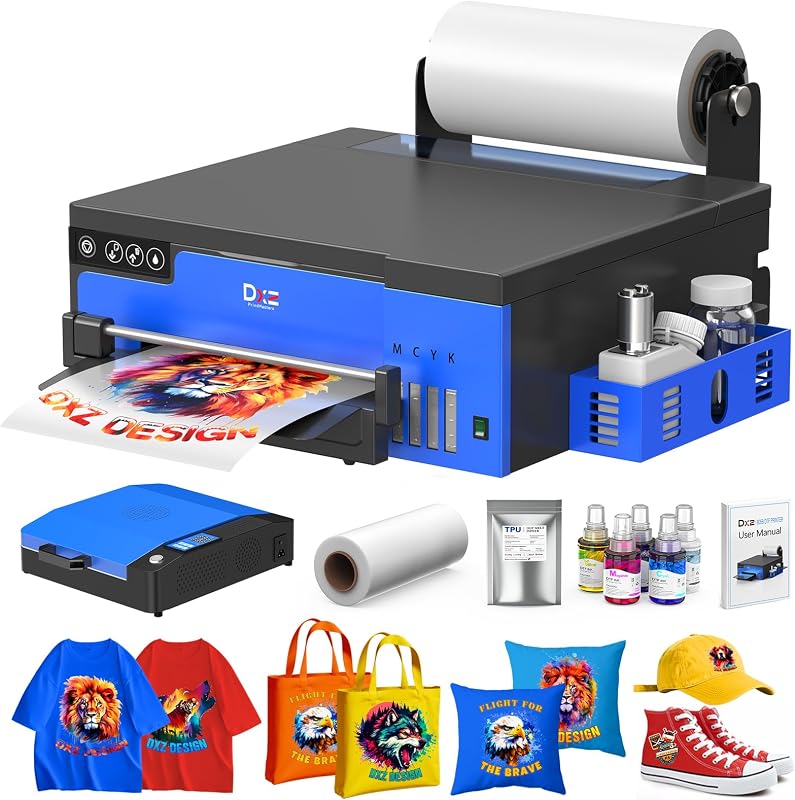
For decorators operating in confined spaces where full A3+ footprints are impractical, the DXZ 2026 A4 DTF Printer offers a compact alternative. Utilizing an XP600 printhead that doubles the output velocity of legacy L1800 and L805 conversions, this machine includes an integrated roll feeder, a built-in white ink stirring system, a companion curing oven, and an extensive two-year ink supply. Solo operators seeking high-speed output on standard chest logos and sleeve graphics will appreciate its downsized A4 chassis, which fits far more comfortably onto everyday craft tables.
Final Verdict
When evaluating whether the investment is sound, answering if the is m1630 dtf printer worth it comes down to matching your production volume with the physical realities of the machine. The bundle successfully resolves several of the most irritating aspects of direct-to-film printing by integrating the control PC, curing oven, and consumables into a single procurement. Furthermore, the inclusion of active fluid circulation alongside an automated film cutter transforms what is often a messy, hands-on crafting chore into a repeatable, semi-automated industrial workflow that handles diverse textiles with remarkable consistency.
Ultimately, this lancelot m1630 pro review finds that the machine excels as a dedicated, stationary workhorse for small commercial garment ventures, screen printing studios adding digital capabilities, and established apparel brands. As long as prospective buyers understand that its 149-kilogram mass precludes casual mobile pop-up use, this turnkey rig delivers the mechanical stamina, maintenance protection, and finishing speed required to build a serious apparel printing business.
FAQ
Does the Lancelot M1630 Pro support Apple Mac computers?
No, the system requires a Windows environment. The included laptop and hardware controllers are compatible with Windows 7, Windows 10, and Windows 11. Mac users must either export their prepared transfer graphics to the bundled Windows laptop via flash drive or local network, or manage the machine using a dedicated PC workstation.
How does the automated film cutter benefit batch production?
The integrated cutter automatically slices the PET film cleanly across the media path once a print job finishes. This eliminates the need for manual trimming with blades or shears, preventing accidental scratching of wet inks, reducing film skew, and ensuring each transfer sheet is ready for direct placement into the curing oven.
What types of textiles and fabrics can you print on?
Because direct-to-film transfers utilize hot-melt adhesive backing applied to the printed design, the transfers adhere securely to cotton, canvas, leather, polyester, and various blended textiles. It supports both light and dark garments since the printer deposits a dedicated white ink underbase beneath all colored pigments.
Can the Lancelot M1630 Pro be transported easily for mobile pop-up printing?
Despite being labeled with portable features, the printer unit weighs 149 kilograms (nearly 330 pounds) and measures 35 inches deep by 29.6 inches high. It cannot be transported or lifted by a single person. Mobile use is only realistic if you operate an enclosed merchandise trailer or professional road crew equipped with ramps and heavy-duty tie-downs.
Why is the white ink circulation system important?
White DTF ink relies on heavy titanium dioxide pigments that settle rapidly when stationary. Without active agitation, the settled ink quickly causes severe nozzle clogs and leads to faint, translucent white underbases. The internal circulation system keeps the white ink continuously moving through the delivery tubes during operation, ensuring stable opacity and protecting the printhead from blockage.


