NETGEAR Orbi 370 Mesh Review: Moving Beyond WiFi 6 on the Road
Read from the Amazon listing on 22 Sep 2026. Figures below are the seller’s; the score is the buyers’.
As Amazon Associates, we earn from qualifying purchases. This means we may receive a small commission at no extra cost to you if you click through and make a purchase.
The NETGEAR Orbi 370 mesh system brings next-generation 802.11be wireless performance to wide workspaces, delivering an effective upgrade for production teams moving beyond aging networking equipment. As camera resolutions rise and collaborative cloud review workflows become the standard for mobile editors, legacy orbi wifi 6 setups frequently run into bottlenecks during heavy multi-gigabit file uploads. The Orbi 370 kit, cataloged under system model RBE373, combines one primary router with two satellite nodes to achieve theoretical speeds up to 5 Gbps across 6,000 square feet. For creative teams building pop-up edit bays in rental houses or temporary production facilities, it supplies a steady network that keeps timeline assets syncing smoothly without sudden drops.
This mesh setup fits traveling production crews, roving digital nomads, and multi-user remote operations requiring dependable coverage and multi-gig incoming broadband support. Capable of supporting up to 70 concurrent devices alongside automated hardware security defenses, it eliminates dead zones across multi-level floor plans while safeguarding private client footage. However, solo creators who travel exclusively with carry-on luggage should look elsewhere, as the three desktop hardware units and their three individual AC power adapters require meaningful bag space. Additionally, international travel crews must take note that the listing restricts this system for use in the United States only.
NETGEAR Orbi 370 at a Glance
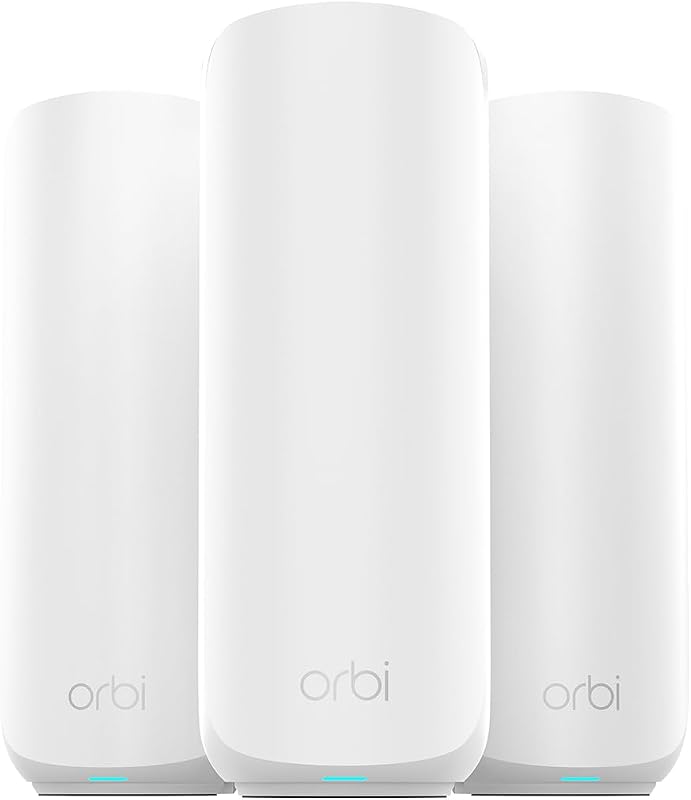
- Buyer score
- 4.9 / 5 on Amazon
- Brand
- Netgear
- Amazon code
- B0FH39S1XJ
Figures above are read from the Amazon product page, not measured here.
- Hardware Model
- RBE373 System (RBE371 Router and two RBE370 Satellites)
- Wireless Protocol
- 802.11be (WiFi 7)
- Frequency Architecture
- Dual-Band with Enhanced Backhaul
- Maximum Speed Rating
- Up to 5 Gbps (2.4X faster than WiFi 6)
- Coverage Footprint
- Up to 6,000 sq ft
- Device Concurrency
- Up to 70 devices
- Wired Interface
- Multi-Gig Ethernet (supports plans up to 2.5 Gbps)
- Antenna Build
- Internal
- Included Equipment
- 1 Router (RBE371), 2 Satellites (RBE370), 1 Ethernet cable, 3 power adapters, Quick start guide
- Regional Restriction
- Made for use in the US only
Multi-Gig Mesh Performance and the Transition from WiFi 6
Listed spec Wireless Protocol 802.11be (WiFi 7)
When comparing orbi wifi 6 vs wifi 7 for production work, the primary justification for an equipment refresh comes down to how efficiently massive media files move across local airwaves. Legacy orbi wifi 6 systems established a strong baseline for home offices, yet multi-camera 4K and 8K workflows require far wider channels and reduced transmission latency. The NETGEAR Orbi 370 utilizes 802.11be technology to push aggregate wireless speeds up to 5 Gbps, which is 2.4 times faster than standard WiFi 6 gear. While actual transfer rates depend on your connected client devices and service provider plans, this additional headroom prevents network congestion when multiple workstations stream footage or upload project archives at the same time.
The network’s physical connection starts with high-bandwidth incoming capabilities. The router features Multi-Gig Ethernet support that is ready for broadband tiers reaching up to 2.5 Gbps. When setting up in temporary rental houses equipped with modern fiber connections, this allows your team to utilize fast incoming bandwidth without hitting standard gigabit limits. For production crews considering larger tri-band options like the orbi 770 series tri-band wifi 7 mesh 3-pack, this dual-band unit serves as a more compact alternative while retaining solid orbi multi-gig mesh performance across critical editing tasks.
Equipment compatibility is straightforward when working on location with mixed client devices. The NETGEAR Orbi 370 maintains backward compatibility with legacy hardware, so older field laptops on WiFi 6, client tablets on WiFi 5, and dedicated control surfaces link up without friction. With the network supporting up to 70 devices simultaneously, teams can run production laptops, mobile phones, media streaming decks, and backup appliances without experiencing connection dropouts or unexpected IP renegotiations.
Field Setup and Network Management for Remote Workspaces
Listed spec Wired Interface Multi-Gig Ethernet (supports plans up to 2.5 Gbps)
Setting up temporary production hubs requires quick deployment without complex network configuration steps. The netgear rbe373 setup relies on the mobile Orbi app, guiding users through a step-by-step installation process to establish the mesh environment. In terms of netgear orbi for remote work, this setup method removes the friction of configuring subnet masks or using manual terminal commands on location. You simply connect the RBE371 router to your host fiber or cable modem using the included Ethernet cable, and the application pairs the satellites to construct a single unified network.
Once the network is active, routine administration is managed directly from a smartphone screen. Creators can organize connected clients, check connection strength between mesh points, and configure a segregated guest network to share access with on-set clients while isolating core editing storage. If you have researched competing setups like the nest wifi 7, you will appreciate that NETGEAR keeps essential network controls straightforward without forcing users through convoluted corporate IT menus.
The hardware is fully compatible with any major internet service provider, integrating smoothly with both cable and fiber installations. When your team moves between different production bases and encounters varied modem gear, the system connects directly to the existing internet gateway. This allows you to bypass sluggish built-in venue routers and deploy a secure, high-speed local wireless network across your entire team.
Coverage Reliability and Dual-Band Enhanced Backhaul
Listed spec Coverage Footprint Up to 6,000 sq ft
Remote production environments often feature awkward architectural hurdles, from thick masonry in older shoot houses to sprawling layouts in converted warehouse studios. The NETGEAR Orbi 370 addresses these barriers by delivering up to 6,000 square feet of whole-home coverage using its three included hardware units. The router and twin satellites employ internal antennas that cast an omnidirectional signal across multiple floors, avoiding awkward external antennas that could break during transport.
A notable element in the netgear orbi 370 specs is the dual-band configuration paired with Enhanced Backhaul engineering. Standard dual-band mesh systems often suffer when node-to-node relay signals share bandwidth with connected laptops. NETGEAR implements Enhanced Backhaul management to coordinate transit between satellites, ensuring stable throughput even when an edit bay is positioned several rooms away from the base router. While users with extreme local file sharing requirements across dense concrete walls might also check tri-band alternatives like the to link deco, the Orbi 370 achieves strong efficiency through modern WiFi 7 spectral management.
Scalability is another practical asset when temporary studio spaces expand beyond initial expectations. According to the manufacturer, users can integrate an additional Orbi 370 Series satellite to add up to 2,000 square feet of coverage per supplementary node. While real-world coverage varies based on building materials and node placement, this expansion path gives traveling crews a modular solution for oversized production bases.
Security Implementations and Threat Defense on Location
Deploying production gear on third-party commercial or residential broadband networks introduces security risks for unreleased client projects. The NETGEAR Orbi 370 addresses these vulnerabilities by enabling core defensive features immediately out of the box. The system integrates exclusive Advanced Router Protection alongside automated firmware updates, ensuring that critical security patches apply quietly in the background without requiring manual intervention from busy crew members.
For operations that demand extra oversight, the package includes a 30-day trial of the NETGEAR Armor security suite. This software acts as an umbrella defense across the mesh network, helping protect connected machines against hackers, malware, and identity threats whether in your primary work base or on the go. This continuous monitoring helps mobile editors detect questionable outbound connections from unvetted devices before sensitive files are compromised.
Keep in mind that continuing with NETGEAR Armor requires a separate paid subscription once the initial 30-day trial concludes. Production managers should factor this recurring operational cost into their gear budgets if corporate non-disclosure agreements mandate continuous real-time threat screening on remote networks.
Packing and Physical Deployment for Traveling Creators
Evaluating hardware suitability for travel involves checking equipment bulk, power requirements, and field transit realities. In this orbi 370 series review, packability is a measured trade-off. The full three-pack includes one RBE371 router and two RBE370 satellites alongside three dedicated AC power adapters and a flat Ethernet cable. While the listing does not specify the exact individual dimensions or weight per unit, the smooth vertical housing and internal antenna design make it simple to slide the towers into padded gear bags without snagging cords.
Power dependency is an operational factor to keep in mind when mapping out workstations. Every node requires an independent AC wall adapter, which means nodes must sit near active wall outlets rather than running from USB-C power banks or camera battery systems. If an outdoor location lacks weather protection, an interior-rated mesh tower cannot be left exposed; in those situations, specialized hardware like the be11000 tp link is better equipped to handle weather-exposed workspaces.
The most important travel limitation to note is that the NETGEAR Orbi 370 is made for use in the US only. Crews undertaking international assignments cannot deploy this system overseas due to domestic regulatory configurations and wireless channel standards. For projects staged within the United States, however, the quick satellite sync and reliable signal distribution offer a practical balance between production-grade throughput and manageable teardown times.
NETGEAR Orbi 370 Pros and Cons
Pros
- WiFi 7 speeds up to 5 Gbps
- Covers up to 6,000 square feet
- Supports internet plans up to 2.5 Gbps
- Handles up to 70 connected devices
- Enhanced backhaul maintains network stability
Cons
- Made for use in the US only
- Requires three separate AC power adapters
- NETGEAR Armor requires paid subscription after trial
Who Should Buy the NETGEAR Orbi 370
Selecting the NETGEAR Orbi 370 comes down to weighing your team’s bandwidth needs against the logistics of moving desktop hardware between work sites.
Buy It If
- You manage production teams working in US-based houses, temporary offices, or multi-level studio spaces up to 6,000 square feet.
- Your projects rely on fast multi-gigabit fiber connections up to 2.5 Gbps paired with local WiFi 7 wireless throughput reaching up to 5 Gbps.
- You need to keep up to 70 concurrent devices online, including workstations, capture equipment, mobile devices, and preview monitors.
- You want guided smartphone installation paired with automated firmware updates and out-of-the-box router protection that requires no ongoing network maintenance.
Skip It If
- You travel internationally, as the hardware is explicitly certified and manufactured for use within the United States only.
- You travel ultralight with a single carry-on bag where three desktop towers and three AC power bricks consume too much packing volume.
- Your workflow uses basic gigabit connections where an existing orbi wifi 6 setup already handles your internet bandwidth without slowdowns.
NETGEAR Orbi 370 Alternatives Worth a Look
If your mobile workflow requires different port selections, broader spatial coverage, or international operation, several other mesh systems offer alternative balances of features.
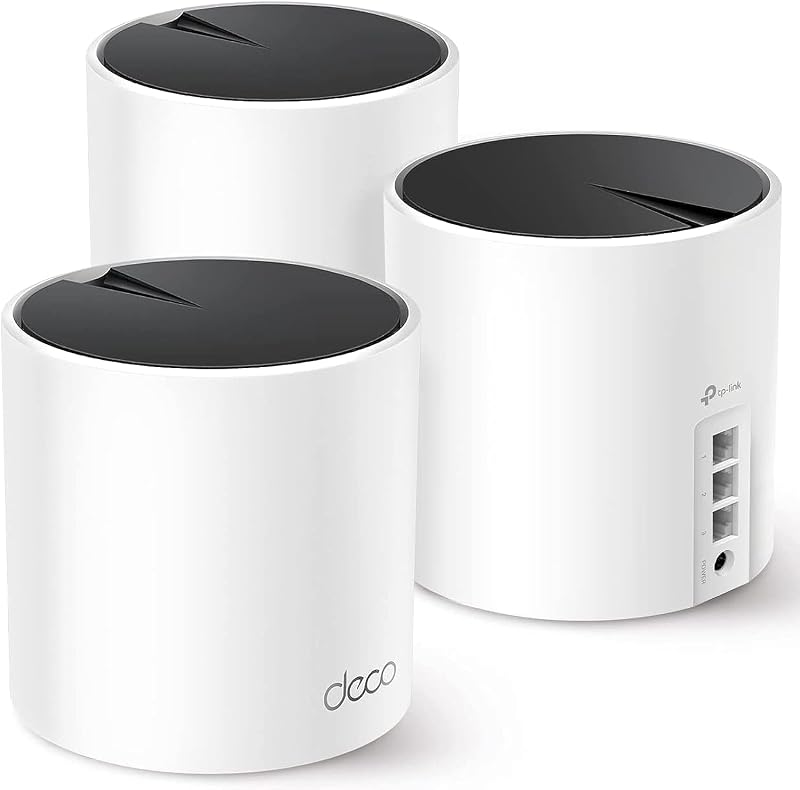
Covers up to 6500 Sq.Ft.
The Covers up to 6500 Sq.Ft. alternative, represented by the TP-Link Deco X55 AX3000 WiFi 6 mesh system, provides up to 6,500 square feet of coverage across a three-pack setup. It features three Gigabit ports per unit, supports Ethernet backhaul, and serves as a direct replacement for traditional wireless routers and range extenders.
This system is a sensible option for remote creators who rely on standard gigabit internet connections and do not need to invest in the advanced multi-gigabit capabilities of WiFi 7.

Up to 6,600 Sq.Ft
The Up to 6,600 Sq.Ft option is the TP-Link Deco BE25 dual-band BE5000 WiFi 7 mesh package. It advertises 4-stream throughput up to 5 Gbps on 240 MHz channels, providing coverage up to 6,600 square feet along with two 2.5G ports per unit for wired backhaul, VPN client support, MLO, and AI-Roaming.
Creative professionals should consider this alternative if their mobile setup relies on dual 2.5G wired connections at every node to run a dedicated network storage drive alongside a hardwired editing computer.

4 x 2.5G Ports Wired
The 4 x 2.5G Ports Wired alternative points to the Deco BE63 Deco 7 Pro tri-band WiFi 7 system. It delivers 6-stream speeds reaching up to 10 Gbps across up to 7,600 square feet, using four smart internal antennas and four individual 2.5G wired ports on every unit alongside HomeShield protection.
This tri-band configuration suits demanding multi-editor field studios that transfer heavy raw footage over local network cables while requiring high wireless bandwidth across auxiliary creative gear.
Final Verdict
When asking is orbi 370 worth it for traveling production units, the choice rests on the bandwidth demands of your remote workspace. Upgrading from older orbi wifi 6 equipment to the NETGEAR Orbi 370 yields a substantial performance jump by pairing 5 Gbps wireless potential with a 2.5 Gbps multi-gigabit internet port. With the ability to blanket up to 6,000 square feet and maintain steady connections across 70 devices, it functions as a dependable backbone for production homes, creative retreats, and multi-room project bases across the United States.
Solo creators who pack light will likely prefer smaller travel routers over carrying three desktop towers and three AC transformers. However, production crews carrying equipment cases will appreciate the rapid app setup, hands-off automated firmware updates, and dependable signal coverage. If your field projects frequently tap into high-speed fiber lines and require modern WiFi 7 efficiency to avoid workflow interruptions, the NETGEAR Orbi 370 provides a well-rounded combination of coverage, speed, and operational dependability.
FAQ
Can older WiFi 6 laptops connect to the NETGEAR Orbi 370?
Yes, the NETGEAR Orbi 370 is backward compatible with earlier wireless generations, including both WiFi 6 and WiFi 5 standards. Your current editing computers, mobile phones, and cameras connect normally, while newer WiFi 7 devices can take advantage of the maximum 5 Gbps speed ceiling.
How many devices can run concurrently on the NETGEAR Orbi 370?
The system is built to support up to 70 connected devices at the same time across the router and satellite nodes. This allows a remote production crew to run multiple editing rigs, smartphones, streaming encoders, and smart displays on one network without bottlenecking traffic.
Can I take the NETGEAR Orbi 370 on international production trips?
No, the product listing explicitly states that the NETGEAR Orbi 370 is made for use in the US only. Production teams traveling overseas must use regionally compliant wireless hardware configured for international radio frequency rules and electrical standards.
Does the NETGEAR Orbi 370 require a subscription for security features?
No, core security functions such as exclusive Advanced Router Protection and automatic firmware updates are enabled out of the box at no added cost. However, the comprehensive NETGEAR Armor security suite—which adds hacker protection, malware defense, and identity security—requires a paid subscription after the 30-day free trial concludes.
How straightforward is the netgear rbe373 setup process on location?
The setup process is simple and handled through the mobile Orbi app. Connecting the RBE371 router to your local modem using the included Ethernet cable initiates guided steps that link the router and satellites within minutes, giving you quick control over device prioritization and guest networks.


