Tapo H100 Smart Hub Review: Ultra-Light Hub for Mobile Workspaces
Read from the Amazon listing on 22 Sep 2026. Figures below are the seller’s; the score is the buyers’.
As Amazon Associates, we earn from qualifying purchases. This means we may receive a small commission at no extra cost to you if you click through and make a purchase.
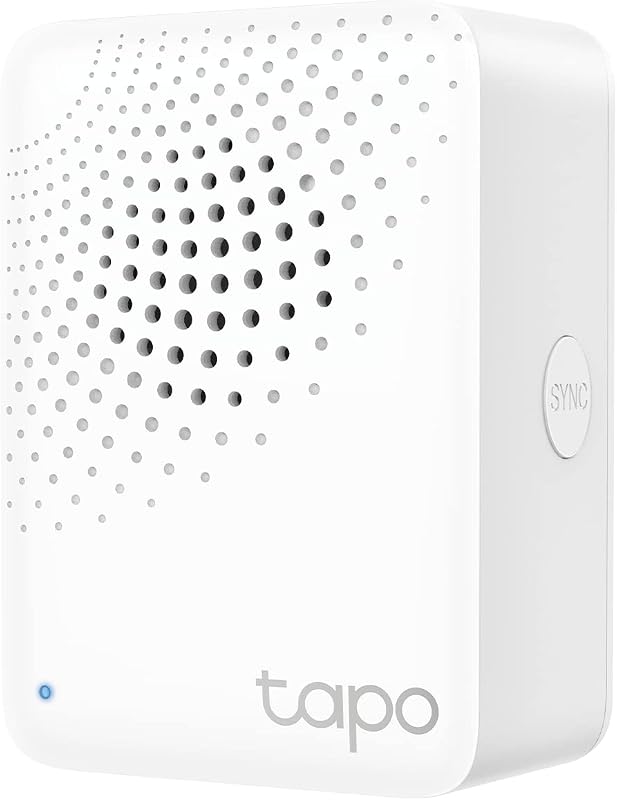
The Tapo H100 is an ultra-compact smart ecosystem coordinator manufactured by TP-Link that functions simultaneously as a hardware bridge, an automated 90 dB acoustic siren, and a custom chime receiver. Measuring an exceptionally small 2.83 x 2.01 x 2.24 inches and weighing a mere 0.07 kg, this wall-mounted unit acts as the centralized management gateway for up to 64 peripheral components, including contact sensors, motion detectors, smart buttons, and wall switches. By utilizing a dedicated sub-band communication link rather than forcing individual battery-powered accessories onto standard wireless networking bands, the hardware achieves stable operational reliability alongside remarkable power conservation. As a streamlined single-piece bridge, our verdict is that the unit provides an extraordinarily portable, stable, and power-efficient foundation for automated monitoring in temporary rentals, office spaces, and residential environments alike.
This compact system is ideally engineered for digital nomads, mobile professionals, and frequent travelers who require reliable temporary lodging security without carrying bulky networking appliances. It also directly benefits minimalist smart home builders who want to monitor doors, windows, and ambient motion across their living quarters without depleting miniature peripheral batteries every few months. Conversely, users who demand direct onboard control for smart light bulbs without Wi-Fi, those searching for integrated Zigbee or Z-Wave compatibility, or individuals needing an untethered, internal battery-operated bridge that works completely disconnected from wall mains power will need to consider different hardware categories.
Tapo H100 at a Glance
- Buyer score
- 4.0 / 5 on Amazon
- Brand
- Tapo
- Amazon code
- B0BYH9KZXS
Figures above are read from the Amazon product page, not measured here.
- Brand and Manufacturer
- Tapo, TP-Link
- Model Number
- Tapo H100
- Item Dimensions
- 2.83 x 2.01 x 2.24 inches
- Item Weight
- 0.07 kg
- Device Capacity
- Up to 64 Tapo devices
- Maximum Operating Range
- Up to 30 meters
- Built-in Siren Output
- Up to 90 dB
- Ringtone Options
- Up to 19 selectable ringtones
- Network Requirement
- 2.4GHz Wi-Fi required
- Control Methods
- App, Voice
- Compatible Sub-Devices
- Tapo Smart Sensors, Tapo Switches, Tapo Buttons
- Package Contents
- 1 x Tapo H100, 1 x Quick Start Guide
- Warranty and Parts
- 1 year manufacturer warranty; 7 years EU spare part availability
Ultra-Compact Form Factor and Mobile Workspace Deployment
Listed spec Item Dimensions 2.83 x 2.01 x 2.24 inches
For remote professionals and frequent flyers, standard smart home hubs present significant logistical friction due to their cumbersome footprints, separate external power bricks, and tangle of Ethernet cables. The tp-link tapo h100 smart hub bypasses these pain points entirely through an integrated, direct plug-in architecture. With structural dimensions of just 2.83 x 2.01 x 2.24 inches and a featherweight profile of 0.07 kg, the device occupies practically zero usable space inside a travel organizer, tech pouch, or carry-on backpack. You do not need to pack dedicated mounting brackets or external DC transformers, as the hub plugs straight into an available standard electrical socket.
When working from short-term rentals, co-working studios, or temporary accommodations, establishing temporary situational awareness has historically required tedious hardware assembly. With this unit, establishing physical perimeter tracking takes only moments after arrival. Setting it up on an outlet near your workstation creates an immediate anchor for accompanying motion detectors and contact sensors placed on luggage cases, rental entryways, or balcony partitions. For digital nomads running extended off-grid workstations or remote basecamps using mobile power banks or portable generators such as the anker solix c2000 gen 2, the low power demands and minuscule mass of the unit make maintaining automated campsite or temporary cabin alarms entirely realistic without straining power supplies.
The physical exterior of the casing is intentionally minimalist, housing internal antennas and sound emitters behind a clean, non-intrusive shell. The product listing specifies external antenna locations suited for walkways, terraces, gardens, sidewalks, lawns, driveways, and garages, confirming the broad environmental placement potential of the system. While the enclosure does occupy a standard outlet space, its narrow side profile helps prevent obstruction of adjacent electrical plugs on standard two-gang outlets or portable power strips.
Low-Power Wireless Protocol and Sensor Battery Conservation
Listed spec Network Requirement 2.4GHz Wi-Fi required
Standard Wi-Fi sensors suffer from notorious power draw, frequently exhausting their miniature coin-cell batteries within a matter of weeks or months because maintaining direct local wireless association demands persistent high-current polling. The tapo h100 low power protocol solves this fundamental flaw by decoupling sensors from the primary local area network. Instead of utilizing direct Wi-Fi links for peripheral communication, the hub interfaces with sub-devices over an ultra-low power wireless protocol that handles periodic check-ins and trigger pulses using an absolute minimum of energy.
According to manufacturer specifications, this specialized low-power transmission protocol extends the operational tapo hub h100 battery life of connected devices by up to 10 times compared to peripherals running on standard high-draw wireless networking links. For travelers, remote field crews, and busy homeowners, this battery longevity delivers immense practical value. You can secure window frames, luggage zippers, door frames, and remote room thresholds without constantly tracking battery replacement intervals or packing sleeves of specialty replacement cells in your luggage.
The operational divide is cleanly managed between the local network and the sub-device network. While the main hub relies on standard 2.4GHz Wi-Fi to communicate outbound status alerts and smartphone notifications, its local cluster of sensors, switches, and tactile buttons communicates purely through the sub-frequency bridge. This architecture ensures that even if local internet service drops momentarily, local sensor handshakes and automated triggers coordinated through the hub continue operating without interruption.
Connection Range and Signal Penetration in Temporary Lodgings
Listed spec Maximum Operating Range Up to 30 meters
One of the primary frustrations encountered when deploying connected hardware across unfamiliar rental properties, multi-story buildings, or sprawling hotel suites is signal degradation caused by thick masonry, metal door jambs, and wireless interference. The Tapo H100 addresses this obstacle by operating its device connection layer on a lower frequency broadband channel. Lower frequency signals experience significantly less ambient signal interference and exhibit vastly superior penetration capabilities through drywall, concrete pillars, and furniture partitions compared to congested 2.4GHz or 5GHz wireless bands.
In terms of physical reach, the tapo hub h100 range supports a maximum connection distance of up to 30 meters between the central hub and its linked sub-devices. This 30-meter radius comfortably accommodates mid-sized residential dwellings, large single-floor apartments, extended suites, and outdoor perimeter zones such as terraces or driveways. The listing emphasizes that this sub-frequency link routinely outperforms standard wireless network systems when managing accessory nodes through challenging structural obstacles.
To ensure steady communication with the Tapo cloud servers and your mobile device, the hub bridges this lower-frequency sensor network into your existing 2.4GHz local Wi-Fi router. Connecting the hub to a high-capacity base station such as the tp-link archer be770 ensures that incoming notifications, Smart Action instructions, and diagnostic logs transmit to the companion smartphone application with virtually zero latency. The clean separation between the 30-meter sensor layer and the primary Wi-Fi uplink prevents device congestion across your primary router bands.
Integrated 90 dB Siren, Chime, and Travel Security Automation
Listed spec Built-in Siren Output Up to 90 dB
Beyond acting as a silent data bridge, the Tapo H100 incorporates an integrated sound generation module that transforms the hardware into a multi-purpose acoustic responder. The unit houses a built-in chime system engineered to perform two critical tasks: sounding high-intensity emergency alarms and serving as an audible alert chime for visitors or daily automation routines. This multi-role design eliminates the necessity of carrying separate sirens or wireless speakers when creating a self-contained monitoring system.
When evaluated as a component for travel awareness, configuring the tapo hub h100 for travel security creates an instant deterrent against unauthorized entry. By linking the hub with compatible Tapo door or window contact sensors and motion detectors, the system can instantly activate a high-decibel siren of up to 90 dB the moment a threshold is breached. In a hotel room, temporary shared workspace, or rental apartment, an immediate 90 dB acoustic siren provides powerful sensory deterrence against opportunistic intruders while instantly rousing sleeping occupants.
For standard daily operations, the hardware functions as a versatile smart doorbell and local notification receiver. When paired with an optional Tapo Smart Button, the tapo h100 chime alarm can emit any of up to 19 selectable ringtones. Users can configure distinct tones for different trigger events, such as a gentle melodic chime when a workspace door opens, a distinct chime when a service button is tapped at a reception desk, and the penetrating 90 dB alarm when a security sensor trips during scheduled night hours.
Network Setup, Device Capacity, and Ecosystem Integration
Listed spec Device Capacity Up to 64 Tapo devices
The procedural workflow for initial tapo h100 setup is straightforward, requiring no technical networking background or specialized wiring. Following the assembly instructions description in the manufacturer documentation, the user simply plugs the unit into an AC receptacle, launches the Tapo smartphone application, connects the hardware to a standard 2.4GHz Wi-Fi network, and initiates the automated pairing sequence. Once the central bridge is linked to the app, adding sub-devices involves putting the peripheral into pairing mode and confirming the connection within the graphical interface.
A single Tapo H100 possesses sufficient routing capacity to manage up to 64 Tapo devices simultaneously throughout an entire property. This allows substantial room for ecosystem expansion, encompassing arrays of motion sensors, entry sensors, smart wall switches, and tactile trigger buttons. Through the Tapo Smart Action engine, the hub coordinates automated conditional logic. For example, detecting motion can automatically command linked smart lights or smart plugs to activate, while a physical press of a paired smart button can run custom shortcuts across your connected environment.
It is crucial to understand the exact device compatibility constraints detailed in the product documentation. The Tapo H100 directly pairs with Tapo Smart Sensors, Tapo Switches, and Tapo Buttons via its proprietary low-power sub-band protocol. However, the listing explicitly notes that the Tapo H100 cannot directly connect to Tapo smart plugs or smart lighting products; those accessories connect over standard 2.4GHz Wi-Fi, though they can still be triggered indirectly through the hub’s Smart Actions. Similarly, traditional wired smart wall controls like the claro smart switch operate under distinct hardware protocols outside this proprietary sub-band ecosystem. Control management is further augmented by voice integration, allowing users to coordinate device routines through popular voice platforms alongside standard mobile application controls.
Tapo H100 Pros and Cons
Pros
- Lightweight 0.07 kg direct plug-in form factor
- Sub-GHz protocol extends sensor battery up to 10x
- Loud integrated 90 dB emergency siren
- Supports up to 64 paired Tapo devices
- 19 selectable chimes for doorbell and alert use
- Reliable connection distance up to 30 meters
Cons
- Requires active 2.4GHz Wi-Fi connection
- No internal backup battery for power outages
- Cannot directly connect Wi-Fi plugs or bulbs
Who Should Buy the Tapo H100
Buy It If
- You travel frequently and need an ultra-lightweight, 0.07 kg plug-in security bridge that deploys in seconds inside hotel rooms or rental apartments.
- You want to maximize peripheral battery longevity, taking advantage of a low-frequency protocol that extends sensor cell life by up to 10 times.
- You require an all-in-one local siren capable of blasting up to 90 dB alarms alongside 19 selectable notification chimes without carrying secondary speakers.
- You are assembling a dedicated Tapo sensor array and need a single bridge capable of managing up to 64 sensors, switches, and buttons.
Skip It If
- You require a completely cordless hub that runs on internal rechargeable lithium batteries without access to an AC wall outlet.
- You expect the hub to provide direct proprietary radio links to smart light bulbs or smart plugs without requiring an existing 2.4GHz Wi-Fi connection.
- You primarily utilize third-party Zigbee, Z-Wave, or non-Tapo peripheral sensors that cannot pair with TP-Link’s proprietary sub-band protocol.
Tapo H100 Alternatives Worth a Look
While the Tapo H100 excels as a lightweight, outlet-bound bridge and acoustic siren for proprietary accessories, shoppers with differing smart home layouts or travel setups may benefit from exploring alternative hardware formats.

Amazon Echo Hub
The Amazon Echo Hub is an 8-inch smart display hub redesigned with customizable control and Alexa+ voice integration, engineered to act as a centralized wall-mounted dashboard compatible with thousands of connected devices. Readers seeking a permanent, visual interactive touch display that coordinates broad multi-brand smart home ecosystems should consider this option instead of the headless, non-display Tapo plug.

Smart Bridge Hub compatible
The Smart Bridge Hub compatible is a specialized home automation controller engineered for motorized blinds and shades, offering full compatibility with Alexa, Google Home, and the Tuya App. If your primary objective is motorizing window treatments and managing shading routines through the Tuya software environment rather than deploying portable door and window contact alarms, this controller is the appropriate selection.

Desktop Hub
The Desktop Hub is an Anker Nano 10-in-1 USB-C docking station featuring dual 2K@240Hz display support, HDMI 2.1, DisplayPort 1.4, 10Gbps USB-C data ports, SD/TF card slots, and an Ethernet interface for laptops. Mobile professionals who searched for connectivity hubs intending to expand laptop display outputs and peripheral computing ports rather than smart home home-security sensors should select this dedicated workstation dock.
Final Verdict
When assessing whether the tp-link tapo h100 smart hub is worth it, the answer depends directly on how much value you place on device longevity, minimal weight, and instant deployment. By operating on a lower frequency broadband spectrum, the device reliably bridges up to 64 sensors and switches across an operating boundary of up to 30 meters while sidestepping the radio clutter that plagues standard Wi-Fi bands. The resulting 10x battery conservation for peripheral hardware delivers tangible peace of mind, freeing users from the continuous chore of replacing depleted miniature sensor cells.
While the requirement for a continuous AC wall connection and an active 2.4GHz Wi-Fi pairing means it cannot serve as an off-grid field transmitter without wall power, its 0.07 kg mass, 90 dB acoustic siren, and 19 selectable doorbell chimes make it an exceptional value. For remote workers, digital nomads securing temporary quarters, and residential smart home builders seeking a clean, low-maintenance sensor foundation, the Tapo H100 stands out as an efficient, highly capable micro-hub.
FAQ
Does the Tapo H100 contain an internal rechargeable battery for power outages?
No, the listing does not specify any internal battery storage. The hardware is designed as a direct plug-in device that draws electrical power directly from a standard wall outlet.
How does the Tapo H100 extend the battery life of connected sensors?
The hub links to Tapo sensors, switches, and buttons using an ultra-low power wireless protocol operating on lower frequency broadband. This transmission method requires significantly less electrical energy than standard Wi-Fi, extending the operational battery lifespan of paired accessories by up to 10 times.
What is the maximum wireless range between the Tapo H100 and paired sensors?
The Tapo H100 supports a maximum connection distance of up to 30 meters. Its lower frequency transmission exhibits lower signal interference, allowing reliable communication through walls and interior partitions.
Can the Tapo H100 connect directly to smart bulbs and smart plugs?
No, the listing explicitly notes that the Tapo H100 cannot directly connect to Tapo smart plugs or smart lighting. Those accessories communicate over 2.4GHz Wi-Fi, although you can still control them or build automated Smart Actions triggered by the hub’s connected sensors and buttons.
How loud is the built-in alarm siren on the Tapo H100?
The internal siren can emit high-decibel alerts reaching up to 90 dB to discourage intruders or warn occupants of potential hazards. Additionally, the unit can produce 19 selectable alternative ringtones when functioning as a chime or doorbell.
How many devices can be connected to a single Tapo H100 hub?
Each Tapo H100 hub can manage and connect up to 64 Tapo devices, including compatible smart sensors, switches, and buttons across your space.