Ultimaker 3 ABS Filament: Built for Durable Field Hardware
Read from the Amazon listing on 8 Oct 2026. Figures below are the seller’s; scores are out of 10, based on listed specifications and buyer feedback.
As Amazon Associates, we earn from qualifying purchases. This means we may receive a small commission at no extra cost to you if you click through and make a purchase.
The Ultimaker 3 ABS Filament is an engineering-grade thermoplastic consumable engineered specifically for seamless deployment on dual-extrusion Ultimaker hardware. Featuring an embedded Near Field Communication chip and a precision-drawn 2.85mm diameter, this two-pound spool of white Acrylonitrile Butadiene Styrene focuses squarely on production reliability, thermal endurance, and dimensional stability. Our verdict is clear: it is an exceptional, low-friction consumable for technical professionals who require structural end-use components and functional prototypes without the setup headaches common to open-market technical filaments.
This filament ideally suits mobile engineers, field researchers, and traveling product designers who deploy an Ultimaker 3 in portable fabrication rigs or remote field offices and cannot afford failed prints or jammed nozzles. However, hobbyists operating standard 1.75mm desktop printers or creators seeking aesthetic multi-color models should look elsewhere, as its diameter and formulation cater strictly to dedicated industrial architectures.
Ultimaker 3 ABS Filament at a Glance

- Our score
- 8.6/10
- Brand
- Ultimaker
- Amazon code
- B06XB3VDND
Figures above are read from the Amazon product page, not measured here.
- Brand
- Ultimaker
- Manufacturer
- Ultimaker BV
- Material Type
- Acrylonitrile Butadiene Styrene (ABS)
- Filament Diameter
- 2.85 millimeters
- Color
- White
- Item Weight
- 2 pounds
- Model Number / MPN
- 1622
- UPC
- 817146020324
- Hardware Integration
- Built-in NFC recognition chip for Ultimaker 3
- Unit Count
- 1 Count (1 Pack)
Mechanical Strength and Structural Integrity
When selecting materials for technical fabrications, mechanical durability dictates whether a finished part survives rigorous field handling or shears under stress. The Ultimaker 3 ABS formulation leverages standard Acrylonitrile Butadiene Styrene properties, granting printed components substantial resistance to physical shock, surface abrasion, and elevated operational temperatures. Unlike standard polylactic acid alternatives that soften inside hot transport vehicles or warp under mechanical strain, ABS retains structural rigidity under continuous mechanical load, making it a dependable option for functional prototypes, electronic enclosures, and bespoke brackets.
Mobile fabricators who must construct durable assemblies on location appreciate the cohesive layer adhesion achieved when running this material through an enclosed extrusion system. While high-resolution resin hardware such as the saturn 3 ultra delivers unmatched visual detail for display pieces, functional engineering components demand the genuine impact resilience and ductile yield that only extruded thermoplastics like ABS provide. The material’s formulation withstands accidental drops on concrete, high-vibration environments, and friction against other mating mechanical parts without shattering.
Additionally, the post-processing versatility of this white ABS adds measurable value to technical workflows. Parts printed from this spool can be machined, drilled, tapped, sanded, or chemically smoothed using vapor methods to achieve fluid-tight seals. For field hardware that interfaces directly with metal fasteners or undergoes repetitive snap-fit cycles, the natural compliance and shear resistance of this filament deliver reliable long-term performance.
Automated Workflow and Smart Material Recognition
Listed spec Material Type Acrylonitrile Butadiene Styrene (ABS)
One of the primary friction points in technical 3D printing is the manual entry of temperature curves, extrusion speeds, and retractions. The integrated Near Field Communication chip mounted directly onto the spool hub transforms the prep stage by communicating directly with the Ultimaker 3 spool holder. The moment the spool rests on the rear hanger, the printer automatically registers the material type, the spool color, and the remaining material volume, transferring these parameters instantly to Cura slicing software.
This automated recognition loop eliminates accidental misconfigurations that frequently ruin technical prints. Operating in temporary workspaces or mobile command stations often introduces distractions; deploying an automated spool guarantees that the system never mistakenly loads a PLA or nylon thermal profile for an ABS print. The slicer receives the exact material telemetry, adjusting cooling fan curves, bed temperatures, and nozzle speeds to match the physical properties of the spool without user intervention.
Furthermore, this communication tracking provides real-time spool monitoring throughout prolonged print sequences. The system tracks material consumption against the active G-code instructions, warning operators if a scheduled build requires more filament than the spool currently holds. For traveling teams working on tight deadlines, preventing mid-print runouts saves valuable fabrication hours and eliminates wasted material.
Dimensional Tolerances and Jam Prevention
Extrusion reliability hinges on strict diameter consistency along the entire length of the spool. This filament is manufactured to a nominal 2.85mm specification with uniform cross-sectional geometry, directly mitigating the risk of mechanical feed binding inside Bowden tube assemblies. Uneven filament diameters create erratic backpressure within the print core, which leads directly to grinding, under-extrusion, or catastrophic hotend clogging.
In dual-extrusion architectures like the Ultimaker 3, hotend reliability is paramount because an extrusion failure in one core can ruin hours of work on a multi-material build. The listing emphasizes a high-quality, consistent diameter engineered specifically to reduce jams, ensuring steady feeder gear traction throughout long extrusion paths. When working out of mobile workspaces, running an automated machine while catching a quick break with a cuisinart barista 4 in 1 coffee maker is only possible when you have absolute confidence that the feed mechanism will not jam unattended.
The clean spool winding also prevents overlapping loops and mechanical tangles. Filament tangles represent one of the most frustrating sources of print failures because they halt the feeder motor without warning. By maintaining uniform tension across the spool during manufacturing, the filament unspools smoothly, maintaining steady resistance from the first meter to the final core layers.
Thermal Management and Field Prototyping Demands
Printing with ABS presents distinct thermal challenges that require thoughtful environmental control, particularly when setting up temporary workstations in variable climates. Because ABS shrinks as it transitions from its molten state to room temperature, draft exposure causes internal stresses that result in corner lifting, base warping, and layer delamination. While the listing does not specify explicit nozzle and bed operating temperatures, the built-in chip automatically applies Ultimaker’s optimized thermal settings directly through the printer interface.
Achieving structural consistency with this filament requires an enclosed build chamber or a draft-free environment to maintain uniform ambient warmth around the cooling part. When deploying equipment in portable labs or dynamic field sites, operators should ensure the front of the printer is shielded from ambient breezes, air conditioning vents, or cold drafts. Controlling the surrounding thermal envelope allows the polymer chains to cool gradually, maximizing inter-layer bonding strength and preventing dimensional distortion.
Ventilation is an equally important consideration for mobile technicians operating in tight workspaces. ABS emits styrene fumes and distinct odors during melting, requiring adequate air circulation or filtration systems in enclosed rooms or portable trailers. Factoring in thermal shielding and proper airflow ensures that field fabrication remains both safe and mechanically reliable across diverse working conditions.
Ultimaker 3 ABS Filament Pros and Cons
Pros
- Integrated NFC chip for automatic material recognition
- Consistent 2.85mm diameter reduces extruder jams
- High impact resistance and structural durability
- Manufactured specifically for Ultimaker 3 printers
- Standard two-pound spool provides ample material
Cons
- Incompatible with common 1.75mm 3D printers
- Requires draft-controlled environment to prevent warping
- Only available in white on this listing
Who Should Buy the Ultimaker 3 ABS Filament
Buy It If
- You operate an Ultimaker 3 3D printer and want full plug-and-play NFC material recognition without manual profile tuning.
- You build functional end-use brackets, mechanical fixtures, or electronic housings that must endure physical shock, friction, and heat.
- You need a dependable 2.85mm filament with tight diameter tolerances to prevent extruder grinding and nozzle clogs during overnight builds.
- You require a technical white polymer that can be easily post-processed, drilled, sanded, or chemically smoothed for professional presentation.
Skip It If
- You own a standard desktop 3D printer that utilizes 1.75mm diameter filament.
- You operate in an open-frame printer environment without draft protection or adequate room ventilation.
- Your primary focus is cosmetic display printing, artistic tabletop figurines, or multi-color decorative models.
Ultimaker 3 ABS Filament Alternatives Worth a Look
If your manufacturing priorities lean toward artistic multicolor printing, smaller hobby spools, or 1.75mm hardware compatibility, several market alternatives offer different material characteristics worth exploring.
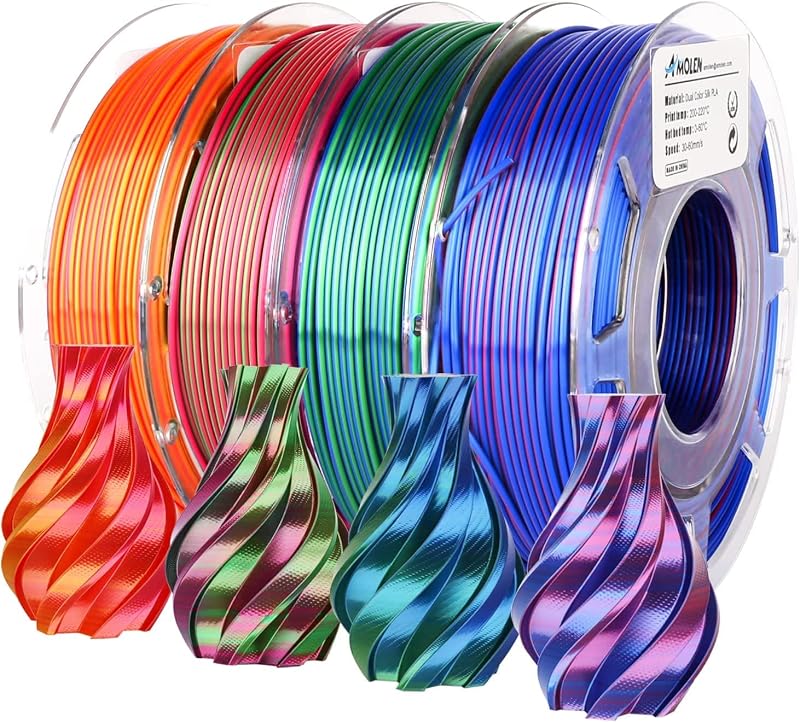
AMOLEN Silk PLA 3D Printer
The AMOLEN Silk PLA 3D Printer filament bundle comes as a four-spool pack containing 200 grams per spool of 1.75mm dual-color silk filament. Unlike the industrial white ABS from Ultimaker, this bundle is tailored for decorative aesthetics, visual prototypes, and vibrant color-shifting display pieces on standard 1.75mm desktop printers. Choose this alternative if you need eye-catching cosmetic finishes rather than high-temperature structural integrity.

Beginner Friendly Multicolor Bundle
The 200g Spool Bundle 3D Printer filament package includes eight 200-gram spools of 1.75mm multicolor glow-in-the-dark PLA+ and tricolor silk filament designed for bubble-free, smooth feeding. This collection targets creative hobby applications, novelty components, and specialty visual items that require unique optical properties. It is the ideal selection for craft-oriented makers who do not require the industrial strength or automated ecosystem of Ultimaker ABS.
Final Verdict
The Ultimaker 3 ABS Filament remains a benchmark consumable for professionals who rely on Ultimaker’s integrated dual-extrusion ecosystem. By pairing an industrial-grade Acrylonitrile Butadiene Styrene polymer with an automated NFC tracking chip, Ultimaker removes the guesswork from temperature regulation, bed leveling coordination, and feed calibration. The tight 2.85mm dimensional tolerances directly address common extrusion failures, giving remote engineers and technical designers the confidence to start complex, multi-hour builds without constant babysitting.
While the specialized 2.85mm diameter restricts its use exclusively to compatible hardware, and the material itself requires thoughtful thermal management to prevent warping, the resulting functional parts speak for themselves. If your objective is producing tough, impact-resistant field equipment, durable enclosures, or functional prototypes on an Ultimaker 3 platform, this filament delivers the consistency, hardware synergy, and structural toughness required to get the job done right.
FAQ
How does the NFC chip on this spool function?
The spool features an integrated Near Field Communication chip that communicates directly with the reader embedded in the Ultimaker 3 spool holder. Once placed on the reel holder, the printer automatically identifies the material type, the color, and the remaining length, instantly configuring the optimal slicer profiles in Cura without manual temperature or speed adjustments.
Can this filament be used on standard 1.75mm 3D printers?
No, this filament has a 2.85mm diameter and is engineered specifically for Ultimaker hardware and compatible 2.85mm extrusion systems. It will not fit through the drive gears, PTFE Bowden tubes, or hotend assemblies of standard 1.75mm 3D printers.
What makes ABS preferable to PLA for field engineering parts?
ABS provides significantly higher impact resistance, better mechanical ductility, and superior thermal tolerance compared to standard PLA. Parts fabricated from ABS can endure rough transport, outdoor heat exposure, and mechanical stress without deforming or cracking under pressure.
Does the product listing specify exact printing temperatures?
The listing does not specify explicit nozzle or heated bed temperatures. Because this filament is manufactured for use with the Ultimaker 3, the embedded NFC chip automatically loads the pre-configured, tested temperature profiles directly into Cura and the printer firmware.
What measures help prevent this ABS filament from warping during printing?
Because ABS shrinks during cooling, maintaining a stable ambient temperature is vital. Using an enclosed printing space, eliminating external room drafts, ensuring the heated bed is properly calibrated, and letting the build plate cool fully before part removal all help prevent warping and base lifting.


