Bambu Lab AMS 2 Pro Multi-Material System: Mobile Creator Analysis
Read from the Amazon listing on 22 Sep 2026. Figures below are the seller’s; the score is the buyers’.
As Amazon Associates, we earn from qualifying purchases. This means we may receive a small commission at no extra cost to you if you click through and make a purchase.
The Bambu Lab AMS 2 Pro represents a substantial evolution in multi-spool automated management, pairing material switching capabilities with integrated thermal conditioning. Designed as an automated material system for modern additive manufacturing, this hardware directly addresses the common points of friction in multi-color and multi-material 3D printing: filament moisture absorption and retraction cycle latency. By integrating an active air vent chamber system capable of reaching 65°C alongside a responsive brushless servo motor, the bambu lab ams 2 pro multi-material system aims to be an all-in-one storage, drying, and distribution station for complex print jobs.
For travelling makers, field technicians, and creators operating out of compact studios or mobile workshops, this hardware consolidates multiple tools into a single desktop footprint. Having filament dried in place without hauling standalone food dehydrators or dedicated heating boxes is a massive logistical advantage. However, creators seeking an ultralight, highly packable field kit may find its physical presence substantial, and owners of legacy printer frames must account for additional hardware requirements before treating it as an effortless drop-in addition.
Bambu Lab AMS 2 Pro at a Glance

- Buyer score
- 4.8 / 5 on Amazon
- Brand
- Bambulab
- Amazon code
- B0F6397NCM
Figures above are read from the Amazon product page, not measured here.
- Item Model Number
- SA007
- Manufacturer
- BAMBULAB Shenzhen Tuozhu Technology Co., Ltd
- Product Dimensions
- 17"D x 12"W x 13"H
- Total Weight
- 4 kg
- Drive Motor Mechanism
- Brushless permanent magnet synchronous servo motor
- Feeding Velocity
- 60% faster feeding speed compared to baseline systems
- Drying System
- Active air vent drying up to 65°C with automatic spool rotation
- Chamber Dehumidification
- Automated venting with airtight sealing for weeks
- Filament Sync
- RFID detection for official Bambu filaments
- Printer Compatibility
- X, P, A, and H series printers
Filament Management and Active Drying Performance
Listed spec Drying System Active air vent drying up to 65°C with automatic spool rotation
Filament moisture remains one of the most persistent obstacles when managing complex print jobs, particularly in temporary workspaces, mobile fabrication trailers, or humid travel environments. The bambu ams 2 pro active drying system tackles this challenge by incorporating an internal heating element and an active air vent mechanism capable of reaching temperatures up to 65°C. During the drying cycle, the internal mechanism continuously rotates the loaded spools, ensuring that heat is evenly distributed across every layer of wound filament rather than baking only the exposed outer wraps.
Moisture removal is managed through an automated venting cycle that actively expels humid air from the internal volume before closing down into an airtight seal. According to the product specifications, this airtight seal allows filaments to remain dehumidified and ready to print for weeks at a time without constant reheats. This sealed design is especially beneficial for hygroscopic engineering plastics. While standard PLA prints reliably in standard ambient conditions, materials such as PETG, ABS, and TPU rapidly degrade when exposed to atmospheric humidity, resulting in stringing, bubbling, and structural delamination if left unprotected.
When integrating this setup into an existing ecosystem, such as pairing it alongside a bambulab a1 combo 3d printer workspace, users must account for specific power demands. While the multi-material feeding functionality operates directly with supported hardware, running the 65°C active drying cycle on X1, P1, and A series printers requires a separate switching adapter. Mobile creators must remember to pack this external adapter if they intend to use the thermal drying feature outside of their primary workshop.
Feeder Speed and Brushless Motor Mechanics
Listed spec Drive Motor Mechanism Brushless permanent magnet synchronous servo motor
Multi-color 3D printing often introduces significant time penalties due to the frequent retractions, purges, and material swaps required at every layer transition. The Bambu Lab AMS 2 Pro addresses this throughput bottleneck by replacing traditional brushed stepper motors with a brushless permanent magnet synchronous servo motor. The manufacturer notes that this upgraded motor drive provides a 60% boost in feeder speed, dramatically cutting down the dead time experienced during filament tool changes.
The upgraded bambu ams 2 pro feeder speed reduces mechanical hesitation during complex print sequences. By applying steady, high-torque feeding via its brushless servo mechanism, the unit feeds and retracts strands through guide tubes with higher mechanical precision and less physical friction. For production runs that demand hundreds of filament swaps across a multi-tone aesthetic or soluble support interface, trimming seconds off each swap aggregates into multiple hours saved over the total duration of a print.
Beyond baseline four-spool switching, the mechanical architecture provides deep expandability for complex multi-material production. On compatible H2D series printers, up to four AMS 2 Pro units and eight AMS HT units can be linked in tandem, allowing creators to run massive setups capable of managing up to 24 separate colors or engineering filaments simultaneously. While a mobile user will rarely haul four separate units into the field, having a drive mechanism that handles high-throughput routing ensures seamless transitions without filament stalling.
Portability, Dimensions, and Mobile Studio Ergonomics
Listed spec Product Dimensions 17"D x 12"W x 13"H
Evaluating the unit from the perspective of an on-the-go designer requires a realistic assessment of physical dimensions and transit weight. Checking the bambu lab ams 2 pro specs reveals an enclosure measuring 17 inches deep, 12 inches wide, and 13 inches high, with a total weight of 4 kg. In a stationary maker lab, this footprint fits neatly alongside or atop compatible enclosures, but for travelling professionals configuring a mobile studio inside a van, flight case, or pop-up trade show booth, allocating that volume requires deliberate planning.
When packing a bambu lab ams 2 pro compact setup, the overall form factor demands dedicated transit protection. The hard-shell black casing protects the internal mechanics and loaded spools from external dust and environmental hazards, functioning as both an active tool and a protective transit case. That said, the 4 kg bambu lab ams 2 pro weight refers strictly to the empty unit; once fully loaded with standard 1 kg filament spools, the total mass climbs significantly. Carrying this system between destinations necessitates a rugged pelican-style container or heavy-duty travel tote rather than a standard backpack.
Despite the heft, using the bambu lab ams 2 pro for travel offers a net space savings compared to carrying separate multi-material feeders, individual dry boxes, and a desktop filament oven. If you run a mobile service vehicle or a traveling prototyping clinic using a machine like the bambu lab p2s 3d printer, replacing three disjointed accessories with one integrated 4 kg unit declutters workbenches and simplifies power distribution in cramped quarters.
Printer Compatibility and System Integration
Listed spec Printer Compatibility X, P, A, and H series printers
Hardware compatibility across generations is critical when investing in material management systems. The listing details explicit ams 2 pro printer compatibility across the Bambu Lab X, P, A, and H series printers. This widespread cross-generation utility ensures that creators who own diverse machine fleets can migrate the unit between different workstations depending on current project requirements, rather than being locked into a single proprietary printer frame.
However, power distribution across these distinct printer chassis is not entirely uniform. While the H series printers can deliver the necessary current natively, owners of X1, P1, and A series machines must deploy a dedicated switching adapter to supply power to the heating elements for the 65°C active drying feature. The feeding, retracting, and multi-color switching operate through the native bus interface, but thermal dehydration cannot function on those older or entry models without the supplementary power accessory. For teams coordinating equipment alongside a bambu lab – p2s ams combo 3d printer, tracking these power cables is vital for smooth mobile deployments.
To further streamline everyday operation, the Bambu Lab AMS 2 Pro includes native RFID filament synchronization. When loaded with official Bambu brand spools, the unit instantly identifies the material type, color, and baseline parameters via embedded RFID tags. This automated recognition removes the need for manual temperature inputs and feed rate configurations in the slicer software, eliminating configuration errors when setting up rapid builds in busy mobile work environments.
Bambu Lab AMS 2 Pro Pros and Cons
Pros
- Active air vent drying reaches 65°C
- Brushless servo motor feeds 60% faster
- Airtight chamber maintains dehumidification for weeks
- Automatic spool rotation ensures even drying
- RFID sync configures official Bambu filaments instantly
- Broad compatibility across X, P, A, and H series
Cons
- Requires switching adapter for drying on X1, P1, A series
- Relatively heavy 4 kg weight before loading spools
- Substantial 17 by 12 by 13 inch footprint
Who Should Buy the Bambu Lab AMS 2 Pro
The Bambu Lab AMS 2 Pro occupies a specialized niche that bridges the gap between everyday desktop printing and high-reliability production manufacturing. Determining whether this unit aligns with your specific workflow depends heavily on your mobility constraints, material choices, and existing printer fleet.
Buy It If
- You frequently print with moisture-sensitive filaments like PETG, ABS, or TPU and require integrated 65°C active drying to prevent humidity degradation.
- You produce intricate multi-color models and want to shorten print durations using the 60% faster brushless servo feeding mechanism.
- You work in field locations, mobile workshops, or humid environments where combining filament storage, drying, and feeding into one enclosure saves crucial counter space.
- You operate compatible X, P, A, or H series printers and value automated RFID material detection for hands-off print job setup.
Skip It If
- You prioritize extreme portability and cannot accommodate a 4 kg, 17x12x13 inch rigid enclosure in your travel luggage.
- You run an X1, P1, or A series printer and do not want to carry or manage a secondary switching adapter to power the drying mode.
- Your workflow is limited to single-color PLA prints where advanced drying cycles and motorized material switching offer minimal return.
Bambu Lab AMS 2 Pro Alternatives Worth a Look
When outfitting a fabrication space or mobile toolkit, shoppers frequently encounter other specialized hardware components across various workshop categories. Here is how distinct utility items compare depending on your specific workshop focus.
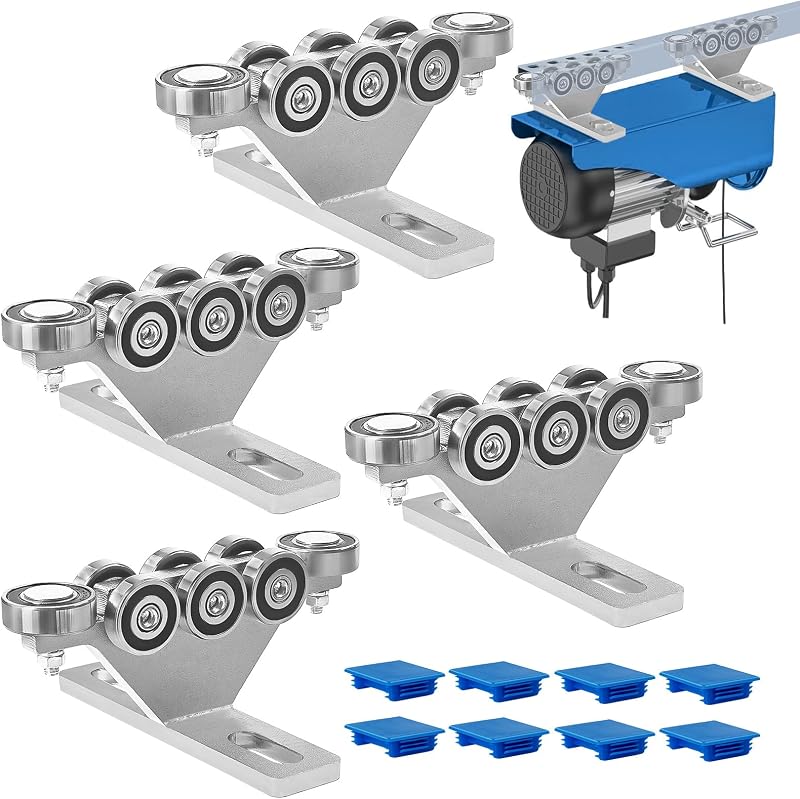
Fits All 1-5 8" Wide
The Fits All 1-5 8″ Wide hardware is a four-pack of unistrut rollers engineered for electric hoists and garage silent trolley systems. Built with a 6+2 wheel configuration featuring anti-lock and anti-fall safety measures, it is designed strictly for heavy workshop overhead rigging rather than desktop 3D printing.
A maker should pick this strut channel trolley if their immediate priority is outfitting an overhead hoist or material lifting rig in a garage workspace rather than managing multi-color filament lines on a desktop 3D printer.

Oscillating Saw Blades Adapter Power
The Oscillating Saw Blades Adapter Power tool accessory is a carbon steel adapter designed to convert multi-tools for use with the Starlock system. Built for woodworking and general DIY applications, it focuses purely on mechanical tool head adaptation.
Makers should choose this adapter if they need to expand their oscillating multi-tool blade compatibility on renovation jobs, rather than seeking automated filament routing and drying solutions for additive manufacturing.

4M 2005
The volume titled 4M 2005 represents the official proceedings of the First International Conference on Multi-Material Micro Manufacture. Unlike physical workshop accessories, this is an academic research publication covering micro-manufacturing theory, precision fabrication processes, and advanced material science.
Engineering researchers or institutional scholars looking for foundational theory on multi-material micro-manufacturing should select this academic text, while active print operators needing hands-on material switching hardware require the Bambu Lab AMS 2 Pro.
Final Verdict
When asking is bambu lab ams 2 pro worth it, the answer depends entirely on how much value you place on integrated material conditioning and feeding velocity. The Bambu Lab AMS 2 Pro successfully merges active 65°C thermal drying, airtight long-term dehumidification, and a rapid brushless servo feeder into an organized, reliable unit. By eliminating the necessity for external filament dehydrators and cutting down multi-color transition times by 60%, it streamlines complex printing operations significantly.
For mobile makers and compact studio operators, the 4 kg weight and 17x12x13 inch footprint are manageable trade-offs for getting a fully contained multi-material environment. While owners of X1, P1, and A series hardware must plan around the external switching adapter to enable full drying functionality, the overall system integration, RFID synchronization, and expansive printer compatibility make the Bambu Lab AMS 2 Pro a formidable multi-material management hub for high-precision creators.
FAQ
What printers are compatible with the Bambu Lab AMS 2 Pro?
The unit provides broad compatibility across the Bambu Lab X, P, A, and H series printers for multi-material printing. However, owners of X1, P1, and A series models need an external switching adapter to supply power to the active drying system.
How hot does the active drying system get on the Bambu Lab AMS 2 Pro?
The active air vent drying system operates at temperatures up to 65°C. During the heating process, the internal rollers automatically rotate the spools to distribute warmth evenly and purge moisture through the automated venting system.
What materials can be loaded into the Bambu Lab AMS 2 Pro?
The manufacturer listing states compatibility with various plastic filaments including PLA, ABS, TPU, and PETG. Its sealed dehumidifying chamber helps protect moisture-sensitive engineering plastics from environmental humidity degradation.
How does the brushless servo motor improve printing performance?
Powered by a brushless permanent magnet synchronous servo motor, the unit achieves a 60% boost in filament feeding speed. This acceleration shortens the time required for material retractions and feed cycles during multi-color or multi-material transitions.
How does the RFID filament sync feature work?
The system integrates an RFID reader that automatically detects official Bambu filaments upon loading. The hardware instantly applies the correct print parameters and optimal drying settings without requiring manual profile configuration by the user.


