SUNLU High Speed PETG: High-Flow Durability for Bambu Lab Printers
Read from the Amazon listing on 18 Oct 2026. Figures below are the seller’s; scores are out of 10, based on listed specifications and buyer feedback.
As Amazon Associates, we earn from qualifying purchases. This means we may receive a small commission at no extra cost to you if you click through and make a purchase.
Fabricating custom camera brackets, drone mounts, and field battery housings demands a material that balances layer adhesion with rapid production cycles. The SUNLU High Speed PETG filament offers a purpose-built solution, blending accelerated melt behavior with structural resilience to serve as an exceptionally capable Bambu Lab PETG HF alternative. Engineered to keep pace with modern motion systems that exceed traditional extrusion limits, this filament provides an agile manufacturing medium for technical hardware.
This material directly benefits travel-focused creators, outdoor videographers, and field technicians who need to manufacture functional, impact-ready assemblies on tight schedules before departing on assignment. Conversely, hobbyists searching for ultra-glossy decorative finishes, multi-color aesthetic miniatures, or casual desktop figurines should look elsewhere, as this spool prioritizes rapid deployment, mechanical utility, and an understated presentation.
SUNLU High Speed PETG at a Glance

- Our score
- 8.0/10
- Brand
- Sunlu
- Amazon code
- B0D9NFF2T8
Figures above are read from the Amazon product page, not measured here.
- Brand
- SUNLU
- Material Type
- Polyethylene Terephthalate Glycol (PETG)
- Manufacturer Part Number
- HSMPETG-BK-1KG
- Filament Diameter
- 1.75 millimeters
- Rated Print Speed Range
- 30 mm/s to 600 mm/s
- Recommended Bed Temperature
- 70°C to 80°C
- Recommended Nozzle Temperature
- 230°C to 270°C (Speed-dependent)
- Surface Finish
- Premium Matte Black
- Spool Net Weight
- 1 kg (35.27 Ounce unit count)
- Manufacturer Warranty
- 1 year manufacturer
Extrusion Flow and Rapid Motion System Throughput
Listed spec Rated Print Speed Range 30 mm/s to 600 mm/s
The primary engineering bottleneck when operating rapid CoreXY machines has historically been the volumetric melt capacity of standard copolyesters. Traditional PETG compositions exhibit high melt viscosity, which frequently forces high-speed printers to throttle acceleration down to pedestrian levels to prevent severe under-extrusion and nozzle clogs. SUNLU addresses this mechanical constraint directly by reformulating the material base for enhanced fluidity. This high-flow modification allows the plastic to liquefy evenly inside standard hotend melt zones, enabling steady flow rates capable of sustaining reliable linear velocities across modern high-speed platforms.
Achieving reliable output across wide velocity brackets depends on calibrating your thermal parameters to machine velocity. According to manufacturer guidelines, slower perimeter work between 50 mm/s and 100 mm/s runs cleanest at 230°C to 240°C, moderate velocities between 100 mm/s and 300 mm/s require 240°C to 255°C, and pushing motion systems into the high speed petg 600mm/s envelope necessitates ramping the nozzle up to 255°C to 270°C. When dialing in Bambu Lab high speed petg print settings on an enclosed machine like the bambu labs p1s, matching your temperature curves directly to flow rate prevents the severe inter-layer separation that standard PETG formulations suffer when pushed past their intended volume thresholds.
By optimizing internal chain fluidity without degrading molecular stability, this filament functions effectively as a Bambu Lab rapid PETG equivalent. Operators can execute rapid prototypes and field replacements in a fraction of standard production time, enabling true on-demand spare part generation when packing tight for remote assignments.
Mechanical Integrity and Field Impact Strength
Field accessories carried across international borders, stowed in utility bags, or clamped to moving vehicles experience relentless mechanical shock, drop risks, and fluctuating temperatures. The SUNLU High Speed PETG formulation bridges the gap between conventional desktop polymers by combining the predictable processing ease of standard PLA with the resilient, fatigue-resistant strength associated with ABS. This hybrid mechanical balance ensures that thin-walled mounting brackets and structural clips flex slightly under acute stress rather than shattering catastrophically.
The core advantage during travel operations lies in verified SUNLU PETG impact strength. Whether you are printing lens support rings, action camera gimbal adapters, or protective shell bumpers, the material withstands repeated drops against tarmac and rocky terrain. Standard PLA components often fracture along structural layer lines when exposed to sudden, sharp mechanical jolts; this modified PETG exhibits higher ductile endurance, absorbing deceleration energy while keeping sensitive electronic payloads intact.
Selecting SUNLU High Speed PETG for travel gear ensures your functional prints survive prolonged transport inside compressed luggage. Because the material naturally maintains the environmental resilience typical of polyethylene terephthalate glycol, it resists moisture degradation and moderate heat exposure far better than standard PLA, ensuring your field rigs maintain dimensional tolerances under harsh midday sun.
Surface Quality and Visual Finish for Technical Rigs
Listed spec Surface Finish Premium Matte Black
A persistent complaint regarding standard copolyester filaments is their highly reflective, glassy sheen, which tends to highlight layer artifacts, stringing traces, and surface imperfections. SUNLU circumvents this cosmetic issue by introducing a specialized additive formulation that produces a premium matte finish upon extrusion. The resulting components feature a soft, even texture that diffuses ambient light, providing an OEM appearance that blends seamlessly alongside professional photography equipment and carbon fiber field rigging.
Utilizing a matte PETG filament for field use offers distinct practical advantages beyond simple visual refinement. On video production sets or observation blinds, reflective plastic gear can create unwanted lens glares or draw unintended attention. The non-reflective surface of this black filament ensures that custom monitor sun-hoods, follow-focus rings, and microphone cold-shoe extensions remain completely discreet under direct artificial stage lighting or intense sunlight.
Furthermore, the micro-textured surface offers superior tactile grip compared to glossy filaments. When handling handheld rig grips, battery sled pull-tabs, or tripod leg locks with wet or gloved hands in cold transit environments, the matte finish delivers enhanced physical purchase, preventing accidental equipment drops during rapid field adjustments.
Bed Adhesion and Machine Compatibility Profiles
Listed spec Recommended Bed Temperature 70°C to 80°C
Transitioning to rapid technical filaments requires consistent bed interface dynamics to prevent corner warping on extended print cycles. SUNLU High Speed PETG specs dictate a heated bed temperature between 70°C and 80°C, establishing solid thermal bond strength on textured PEI sheets, smooth high-temperature plates, and engineering build surfaces. This thermal requirement keeps the footprint anchored through violent directional shifts when toolheads accelerate at aggressive travel speeds.
The 1.75mm diameter manufacturing tolerance ensures smooth feeder engagement across both direct-drive setups and Bowden configurations. Makers operating open-frame desktop units like the a1 3d printer will find the filament feeds predictably through automated multi-material feeder systems without excessive filament shaving or motor skipping, provided retractions are calibrated cleanly to prevent fine hairs along unretracted moves.
When migrating from baseline prototyping materials such as bambu pla basic, operators should note that this high-flow PETG demands slightly higher print bed heat and well-tuned cooling fan curves. Because PETG requires adequate heat retention to guarantee high-strength layer fusion, setting part-cooling fans too high will compromise part toughness, whereas balanced fan speeds preserve dimensional accuracy on overhangs without sacrificing inter-layer bonding.
SUNLU High Speed PETG Pros and Cons
Pros
- High-speed flow rated up to 600mm/s
- Enhanced impact strength combines PLA and ABS benefits
- Premium low-glare matte black surface finish
- Broad temperature range up to 270°C
- Wide compatibility across Bambu Lab and FDM hardware
Cons
- Requires elevated nozzle temperatures at maximum speeds
- Mandates heated print bed between 70-80°C
- Lacks the glossy look of traditional PETG
Who Should Buy the SUNLU High Speed PETG
Buy It If
- You need a dependable Bambu Lab PETG HF alternative that matches aggressive volumetric print profiles without causing mid-print nozzle starvation.
- You manufacture functional travel equipment, drone guards, or camera support accessories that demand high impact resilience and fatigue resistance.
- You prefer a non-reflective, refined matte finish that mimics injection-molded components rather than glossy plastic parts.
- You own high-speed FDM hardware capable of utilizing elevated nozzle temperatures up to 270°C for rapid production.
Skip It If
- Your projects consist purely of visual display pieces, artistic statuettes, or multi-tone craft prints where silk sheen is preferred.
- Your printer lacks a heated build plate capable of maintaining steady temperatures between 70°C and 80°C.
- You only print slowly at default lower temperatures and do not require the thermal or mechanical toughness of a fortified copolyester.
SUNLU High Speed PETG Alternatives Worth a Look
If your workflow shifts toward cosmetic display models or colorful prototyping where high impact strength is secondary, several alternate filament options provide different visual properties and spool setups.
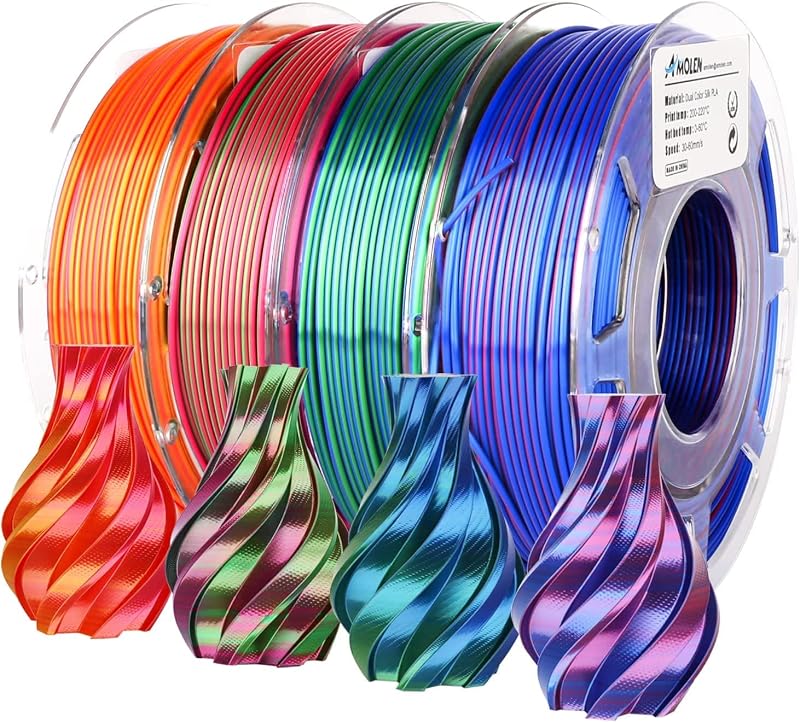
AMOLEN Silk PLA 3D Printer
The AMOLEN Silk PLA 3D Printer bundle provides four 200g spools of shiny dual-color filament. While it lacks the high impact strength, elevated thermal ceiling, and rugged structural toughness of SUNLU high-speed copolyester, it serves users fabricating decorative desk pieces, cosplay accents, or visually striking craft items that benefit from a high-sheen, color-shifting finish.

Beginner Friendly Multicolor Bundle
Makers needing a broad palette for simple prototyping without high-temperature requirements should look at the Beginner Friendly Multicolor Bundle. This set includes eight 250g spools of SUNLU PLA filament in varied colors, offering an accessible starting point for low-stress indoor projects, desk organization trays, and color-coded components that do not encounter outdoor field stresses.

200g Spool Bundle 3D Printer
The 200g Spool Bundle 3D Printer package combines tricolor silk and glow-in-the-dark PLA+ filaments across eight compact rolls. This assortment fits hobbyists looking to produce specialty display objects, novelty gifts, or night-visible markers, rather than rugged functional mounts engineered for rapid toolhead motion and heavy mechanical abuse.
Final Verdict
When asking if the SUNLU High Speed PETG is worth it for demanding travel setups and mobile production kits, the answer depends on your performance requirements. By resolving the melt rate bottlenecks that traditionally throttle copolyester filaments on modern CoreXY platforms, this material delivers rapid production capabilities while preserving the environmental durability, layer cohesion, and impact resistance needed for functional field hardware.
Its combination of PLA-like printing reliability, ABS-grade durability, and an understated matte surface makes it an exceptional choice for technical creators. For anyone seeking a dependable drop-in filament that maximizes high-speed motion hardware to produce rugged outdoor rigs, this formulation stands as an outstanding asset in any mobile maker toolkit.
FAQ
How does SUNLU High Speed PETG compare to Bambu Lab PETG HF?
This filament serves as a direct functional alternative designed for high-flow extrusion, featuring a 30 mm/s to 600 mm/s speed ceiling and an even matte finish that matches the rapid feed requirements and structural expectations of high-speed Bambu Lab print profiles.
What nozzle temperatures are required across different print speeds?
For low speeds between 50 mm/s and 100 mm/s, set nozzle temperatures to 230°C to 240°C. Medium speeds between 100 mm/s and 300 mm/s require 240°C to 255°C, while high-speed printing from 300 mm/s up to 600 mm/s requires ramping heat to 255°C to 270°C to maintain uniform melt flow.
Can I use SUNLU High Speed PETG for outdoor travel gear?
Yes, the material incorporates enhanced toughness and high impact resistance, combining the resilience of ABS with the processing ease of PLA. This makes it well suited for camera cages, drone clips, and mobile field accessories that must endure impacts, vibration, and travel wear.
Does this filament leave a glossy or matte surface texture?
The filament produces a soft, uniform matte finish that significantly reduces the glassy sheen common to traditional PETG plastics, resulting in an understated, low-glare surface ideal for camera accessories and tactical mounting hardware.
What bed temperature is necessary for reliable adhesion?
The manufacturer recommends maintaining a heated bed temperature between 70°C and 80°C to prevent edge lifting and ensure consistent bottom-layer adhesion throughout rapid motion sequences.