QIDI Plus4 3D Printer: Stationary Muscle with Remote Studio Freedom
Read from the Amazon listing on 16 Oct 2026. Figures below are the seller’s; scores are out of 10, based on listed specifications and buyer feedback.
As Amazon Associates, we earn from qualifying purchases. This means we may receive a small commission at no extra cost to you if you click through and make a purchase.
The QIDI Plus4 is a heavy-duty, enclosed CoreXY machine engineered to bring industrial-grade thermal control and high-speed manufacturing into a unified package. Built with an actively heated chamber, an ultra-high-temperature hotend, and integrated network connectivity, it serves as a relentless manufacturing anchor capable of tackling demanding technical filaments without the warping issues common to open-frame hardware. For remote professionals and traveling creators who cannot babysit jobs in person, this machine delivers dependable desktop manufacturing with the reassurance of full off-site management.
This enclosed powerhouse suits hardware developers, prototyping engineers, and production studios that demand high-temperature material handling and off-desk oversight through wireless workflows. Creators managing projects across multiple locations will appreciate being able to dispatch, monitor, and troubleshoot builds without remaining tethered to a workbench. However, those needing a lightweight field companion for portable travel kits should explore ultra-compact alternatives like the prusa mini plus 3d printer, as this massive unit is engineered strictly for permanent tabletop installation.
QIDI Plus4 at a Glance

- Our score
- 9.0/10
- Brand
- R Qidi Technology
- Amazon code
- B0DBQ8MZX6
Figures above are read from the Amazon product page, not measured here.
- Build Volume
- 12 x 12 x 11 inches
- Chamber Heating
- Active 65°C heating with 400W dedicated power
- Max Nozzle Temperature
- 370°C
- Hotend Rating
- 80W high-temperature hotend with multi-metal integrated throat nozzle
- Motion Architecture
- CoreXY structure
- Chamber Design
- Dual-layer insulation with air circulation
- Bed Platform
- 6mm thickened aluminium hot bed
- Z-Axis System
- Independent dual motor-driven Z-axis with 10mm linear shafts and lead screws
- Product Dimensions
- 19.29"D x 20.07"W x 22.24"H
- Item Weight
- 27 kg
Active Chamber Heating and Thermal Stability
Listed spec Chamber Heating Active 65°C heating with 400W dedicated power
The centerpiece of the machine is its second-generation active chamber heating system, which elevates internal enclosure temperatures up to 65°C. Powered by a dedicated 400W heating element, the system does not rely on passive residual warmth rising from the build plate. Instead, it actively drives conditioned air through an integrated circulation channel, establishing a uniform thermal envelope from the first layer to the top of the build volume. Dual-layer insulation lines the enclosure, trapping warmth efficiently while shielding internal ambient temperatures from external room drafts and fluctuations.
Maintaining a stable elevated temperature is vital when working with advanced engineering thermoplastics that suffer from violent shrinkage when cooled unevenly. The active 65°C environment neutralizes internal stress during cooling, effectively eliminating edge curling, base warping, and layer delamination on long, dense components. For demanding production batches, this thermal consistency transforms difficult industrial materials into reliable everyday options, ensuring dimensional accuracy across parts that span the full 12 x 12 x 11-inch build area.
Thermal management is further reinforced by the heavy-duty 6mm thickened aluminium hot bed platform. This substantial plate resists thermal deformation under sustained cycles, providing a rigid and flat foundation across the entire surface. By combining an insulated enclosure, forced-air circulation, and a massive heated bed, the thermal subsystem guarantees that the bottom layers experience the exact same thermal conditions as tall overhangs, delivering structural integrity on critical functional prototypes.
High-Temperature Extrusion and Nozzle Capabilities
Listed spec Max Nozzle Temperature 370°C
Feeding the build volume is an upgraded 80W high-temperature hotend capable of reaching a maximum temperature of 370°C. This extreme operating threshold unlocks a wide material compatibility spectrum, allowing users to process high-performance technical filaments that defeat standard consumer extruders. The assembly utilizes a multi-metal integrated throat nozzle engineered to conduct heat rapidly while maintaining a sharp transition zone, preventing heat creep even when operating inside an actively heated 65°C chamber.
Maintenance and nozzle swaps are streamlined thanks to an integrated mechanical layout designed for faster installation and removal. The seamless throat-and-nozzle geometry reduces the interior gaps and micro-crevices where molten filament typically pools and degrades, significantly lowering the risk of clogs during extended production runs. For studios producing functional prototypes, structural brackets, or end-use enclosures, this uninterrupted throughput ensures that high-melt-point polymers extrude consistently without sudden under-extrusion.
The extrusion system also incorporates an integrated mechanical filament cutter, which plays a crucial role in automated filament management. This hardware design prepares the machine for multi-material workflows, including compatibility with the QIDI BOX multi-filament automatic feeding unit. Having a clean, automatic mechanical cut at the toolhead guarantees smooth transitions between spools, minimizing feed resistance and preventing material jams during multi-color or multi-material fabrication jobs.
Remote Monitoring and Mobile Studio Control
For creators who spend significant time away from their physical workspace, the integrated remote monitoring suite turns the printer into an accessible fabrication hub. An onboard HD camera provides a live visual feed directly to the QIDI mobile app or the QIDI Studio slicer, letting you check first-layer adhesion, monitor bridge structures, and generate automated time-lapse videos from anywhere in the world. Instead of remaining chained to a workbench, users can oversee ongoing production runs directly from a smartphone or laptop while traveling.
The software environment pairs this visual oversight with full real-time telemetry and wireless job dispatch. From the mobile application, operators can track active chamber temperatures, monitor nozzle readouts, adjust feed rates, or pause execution instantly if a print issue emerges. Those accustomed to compact mobile-friendly ecosystems like the bamboo labs a1 mini will recognize the convenience of mobile management, but here that capability is paired with a heavy-duty production platform capable of extreme temperatures.
Safety and process reliability are augmented by integrated filament wrap and break detection sensors. If a spool snarls or snaps mid-print, the system pauses execution automatically and flags an alert through the network interface, safeguarding hours of progress and preventing hotend heat damage. Backed by an out-of-box experience that takes only 10 minutes from unboxing to initial printing, the machine integrates into wireless studio workflows with minimal configuration downtime.
CoreXY Motion Dynamics and Structural Build
Listed spec Build Volume 12 x 12 x 11 inches
High-speed fabrication requires a rigid motion system, and this printer inherits the proven CoreXY architecture established in earlier generations. By utilizing stationary stepper motors to drive lightweight belts across the XY gantry, the toolhead achieves rapid accelerations and swift directional shifts without dragging heavy motors along the moving axes. This design minimizes mechanical vibration, allowing the printer to maintain sharp corner definition and clean surface finishes even during high-velocity production runs.
Z-axis stability is handled by an independent dual motor-driven platform. Rather than linking both sides of the bed to a single drive belt that can slip or stretch over time, twin independent motors drive dedicated lead screws. This setup ensures that the heavy 6mm aluminium bed maintains level alignment relative to the gantry throughout towering print jobs, eliminating z-banding artifacts and layer shifts across the vertical 11-inch build height.
To support this high-mass bed and withstand high-speed toolhead motion, the internal mechanical framework features upgraded 10mm diameter linear shafts and lead screws. The beefier guide shafts resist flex under dynamic loads, ensuring that the toolhead follows a true trajectory regardless of speed. Combined with an ABS and metal structural chassis, the rigid frame dampens acoustic resonance and mechanical vibration, establishing the dimensional accuracy required for interlocking mechanical components.
Studio Footprint and Production Readiness
Listed spec Product Dimensions 19.29"D x 20.07"W x 22.24"H
The physical presence of the machine reflects its heavy-duty industrial intent. With exterior dimensions of 19.29″D x 20.07″W x 22.24″H and an overall weight of 27 kg, this printer demands a dedicated, stable benchtop. It is not an appliance designed to be moved between rooms or transported in vehicle trunks. While entry-level desktop machines like the creality ender 3 v3 se 3d prioritize a slender desk footprint, this machine trades compact portability for thermal mass, structural rigidity, and expansive capacity.
That stationary footprint delivers a generous 12 x 12 x 11-inch build volume, enabling studios to produce large-scale prototypes in a single pass rather than splitting models into multiple glued sections. For high-throughput workshops, the spacious bed accommodates large arrays of smaller parts in single batches, maximizing unattended production efficiency while the operator works off-site. The silver exterior finish and fully enclosed aesthetic maintain a professional appearance suitable for engineering offices and design studios.
Future-proofing is integrated directly into the chassis architecture. Beyond its single-material capabilities, the printer includes native hardware provisions for the upcoming QIDI BOX automatic multi-filament feeding system. This multi-material unit expands the machine’s repertoire into complex multi-color visual models, soluble support structures, and combined rigid-flexible parts, establishing the platform as a versatile long-term investment for commercial prototyping environments.
QIDI Plus4 Pros and Cons
Pros
- Active 65°C chamber heating with 400W power
- High-temperature 370°C integrated multi-metal nozzle
- Generous 12 x 12 x 11-inch build volume
- Independent dual motor Z-axis with 10mm shafts
- Built-in HD camera for live remote monitoring
- Fast 10-minute setup from unboxing to printing
Cons
- Heavy 27 kg weight prevents easy portability
- Large exterior footprint requires dedicated bench space
- Multi-filament QIDI BOX requires separate 2025 launch
Who Should Buy the QIDI Plus4
Buy It If
- You need active 65°C chamber heating to print warp-prone engineering filaments without layer splitting.
- You manage prototyping jobs remotely and rely on an HD camera, mobile app, and network slicer to oversee prints.
- You require a generous 12 x 12 x 11-inch build volume supported by heavy-duty 10mm shafts and dual Z-axis motors.
- You want a high-temperature 370°C hotend that can handle technical polymers right out of the box.
Skip It If
- You need a lightweight, ultra-portable 3D printer that can easily fit into mobile travel bags or compact carry-ons.
- Your workspace lacks a reinforced, permanent table capable of supporting a 27 kg machine with wide exterior dimensions.
- You exclusively print standard low-temperature PLA and do not need active chamber heating or a 370°C nozzle.
QIDI Plus4 Alternatives Worth a Look
If your manufacturing requirements lean toward multi-color consumer convenience, open-frame portability, or different enclosure architectures, consider these alternatives from the same market segment.

MakerWorld Model Library
The MakerWorld Model Library package highlights the Bambu Lab P1S Combo with an included AMS unit for multi-color printing. It features a ready-to-use CoreXY structure, auto bed leveling, and seamless access to an extensive model library. Choose this setup if your primary focus is out-of-the-box multi-color printing and integrated model sharing rather than high-temperature active chamber heating.

FLASHFORGE Adventurer 5M 3D Printer
The FLASHFORGE Adventurer 5M 3D Printer is a high-speed CoreXY machine with a 220 x 220 x 220 mm build volume, max 600 mm/s printing speed, fully auto leveling, and a 280°C direct extruder featuring a 3-second detachable nozzle. It offers a more compact footprint and rapid nozzle maintenance, making it an appealing option for creators who want fast desktop production without the massive physical size of an industrial enclosure.
Beginner-Friendly Ecosystem with MakerWorld Model
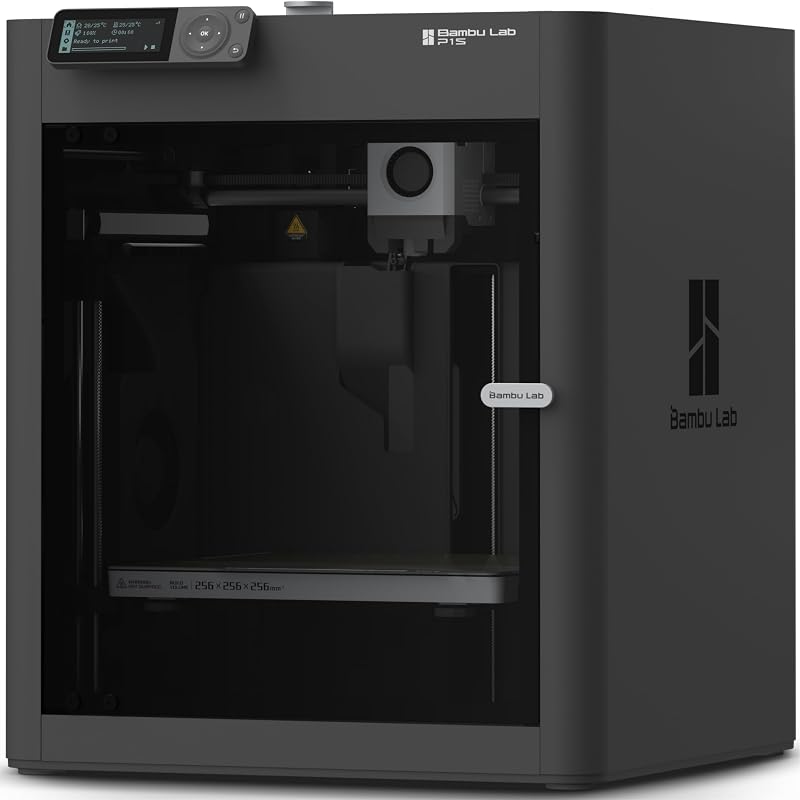
The Beginner-Friendly Ecosystem with MakerWorld Model listing features the standalone enclosed CoreXY Bambu Lab P1S 3D printer. Designed for high speed, precision printing, and minimal setup hassle, it caters to users who prioritize an intuitive software ecosystem and enclosed reliability for standard materials, without needing the 370°C hotend or 400W active chamber heater found on industrial platforms.
Final Verdict
The QIDI Plus4 stands out as a purpose-built desktop factory that bridges the gap between consumer CoreXY speed and true industrial thermal management. With its dedicated 400W active chamber heater reaching 65°C and an integrated 370°C hotend, it delivers the precise environmental control required to tame difficult engineering plastics. The reinforced motion system, featuring 10mm guide shafts and independent dual Z-axis motors, guarantees that large-scale parts across the 12 x 12 x 11-inch build space finish with consistent structural integrity.
For traveling editors, remote designers, and production engineers, its integrated HD camera and comprehensive mobile connectivity provide the operational freedom to run complex jobs from anywhere. While its 27 kg mass and substantial exterior dimensions make it entirely unsuitable for mobile travel kits, it serves as an uncompromising, reliable home-base anchor for serious prototyping. If you need industrial material versatility backed by effortless off-site management, this machine delivers exceptional functional value.
FAQ
What are the primary QIDI Plus4 specs?
The printer features a 12 x 12 x 11-inch build volume, an active 65°C chamber heater powered by a 400W heating element, an 80W hotend reaching up to 370°C, a CoreXY motion structure, an independent dual motor Z-axis, 10mm linear shafts, and a 6mm thickened aluminium heated bed platform.
How does QIDI Plus4 remote printing work while traveling?
The printer connects via network to the QIDI mobile app and QIDI Studio slicer, allowing users to send print jobs wirelessly, monitor thermal telemetry, pause or cancel execution, and view live video through an integrated HD camera equipped with time-lapse capabilities.
What is the maximum temperature of the QIDI Plus4 chamber heating?
The active chamber heating system reaches up to 65°C using a 400W heating element with forced air circulation and dual-layer insulation to ensure even heat distribution and prevent model warping.
What are the exact QIDI Plus4 weight and dimensions?
The printer measures 19.29 inches deep, 20.07 inches wide, and 22.24 inches high, with a total item weight of 27 kg, requiring a dedicated, sturdy workbench.
Does the QIDI Plus4 support multi-colour printing?
Yes, the printer includes an integrated filament cutter and is designed to be compatible with the QIDI BOX multi-filament automatic feeding system, scheduled for launch in early 2025.